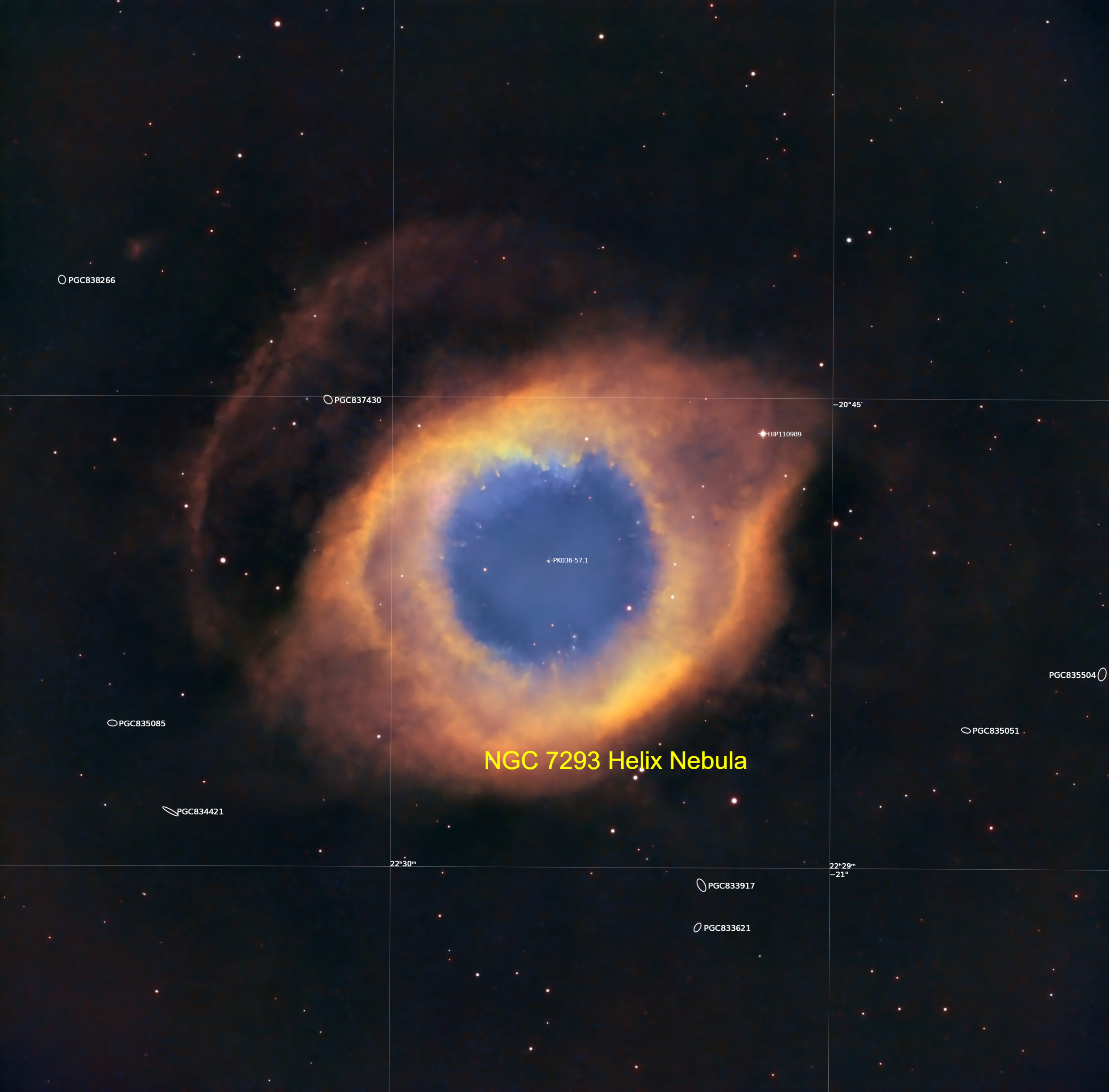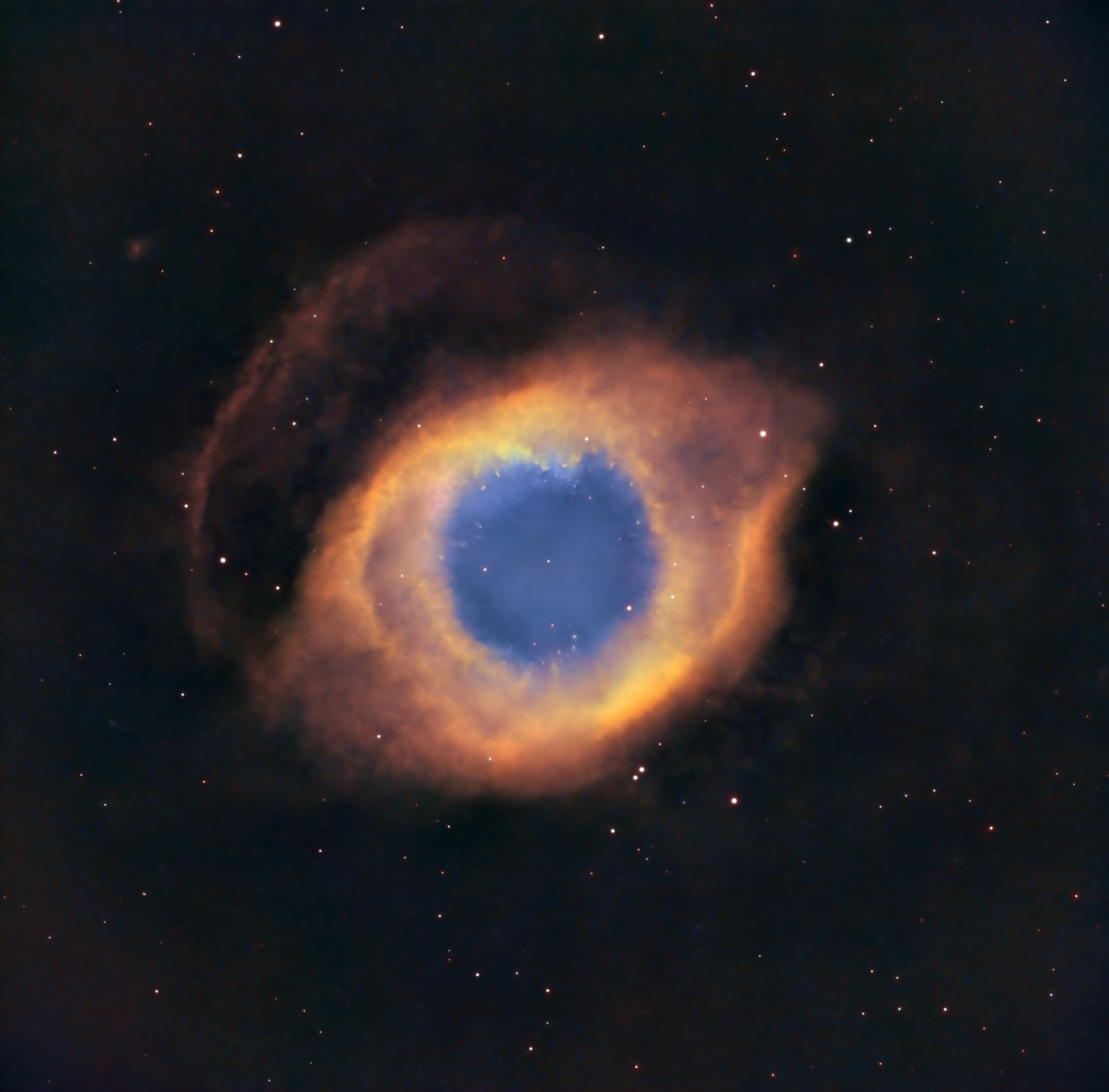
(Note: The Helix Nebula’s official catalog designation is NGC 7293—rather than NGC 2793—often nicknamed the “Eye of God”.)
Overview of the Helix Nebula (NGC 7293)
The Helix Nebula is one of the closest and most striking planetary nebulae known to astronomy. Located roughly 655 to 700 light-years away in the constellation Aquarius, it spans approximately 2.5 to 3 light-years across. Because of its vibrant colors and distinct concentric ring structure that resembles a giant eye staring out into space, it has earned the popular moniker the “Eye of God” or “Eye of Sauron” in pop culture.
Key Characteristics
-
Classification: Planetary Nebula (despite the misleading name, these have nothing to do with planets; the term arose historically because early astronomers thought they looked like green gas giant planets through small telescopes).
-
Distance: ~650–700 light-years from Earth.
-
Constellation: Aquarius.
-
Caldwell Catalog: Listed as Caldwell 63.
How It Formed: The Life Cycle of a Star
The Helix Nebula offers a preview of what our own Sun might look like at the end of its life:
-
The Red Giant Phase: Billions of years ago, the central star of the Helix Nebula was an ordinary, Sun-like star. As it exhausted the hydrogen fuel in its core, it swelled into a red giant, shedding its outer gaseous envelopes into space.
-
The White Dwarf Core: What remains at the exact center of the nebula is a hot, incredibly dense white dwarf star. This remnant core no longer undergoes nuclear fusion; instead, it glows purely from residual heat, slowly cooling down over billions of years.
-
Illuminating the Gas: The ultraviolet radiation pouring out from this dying central white dwarf causes the surrounding expanding shells of gas and dust to fluorescence brightly, creating the brilliant colors captured by space telescopes like Hubble.
Fascinating Features: Cometary Knots
High-resolution images from observatories like the Hubble Space Telescope have revealed an intricate network of more than 20,000 comet-like knots embedded within the nebula’s gas ring.
-
These knots consist of dense clumps of dust and gas with tails stretching outward away from the central star, shaped by the stellar wind and intense radiation blasting from the dying core.
-
Though they are called “cometary,” they are actually massive—many are roughly the size of our entire Solar System!
Acquisition details
Equipment
Telescope : Askar 151PHQ
Mount : Skywatcher EQ8r Pro
Camera : ZWO 533mm pro
Filters : Anitlia 3.0 Nm Pro filters Ha, Oiii, Sii
Dates : 08/08/2026 – 14/08/2026
Frames : HA 300*71, Oiii 300*30, Sii 300*22
Total Time : 10Hrs 15 Minutes