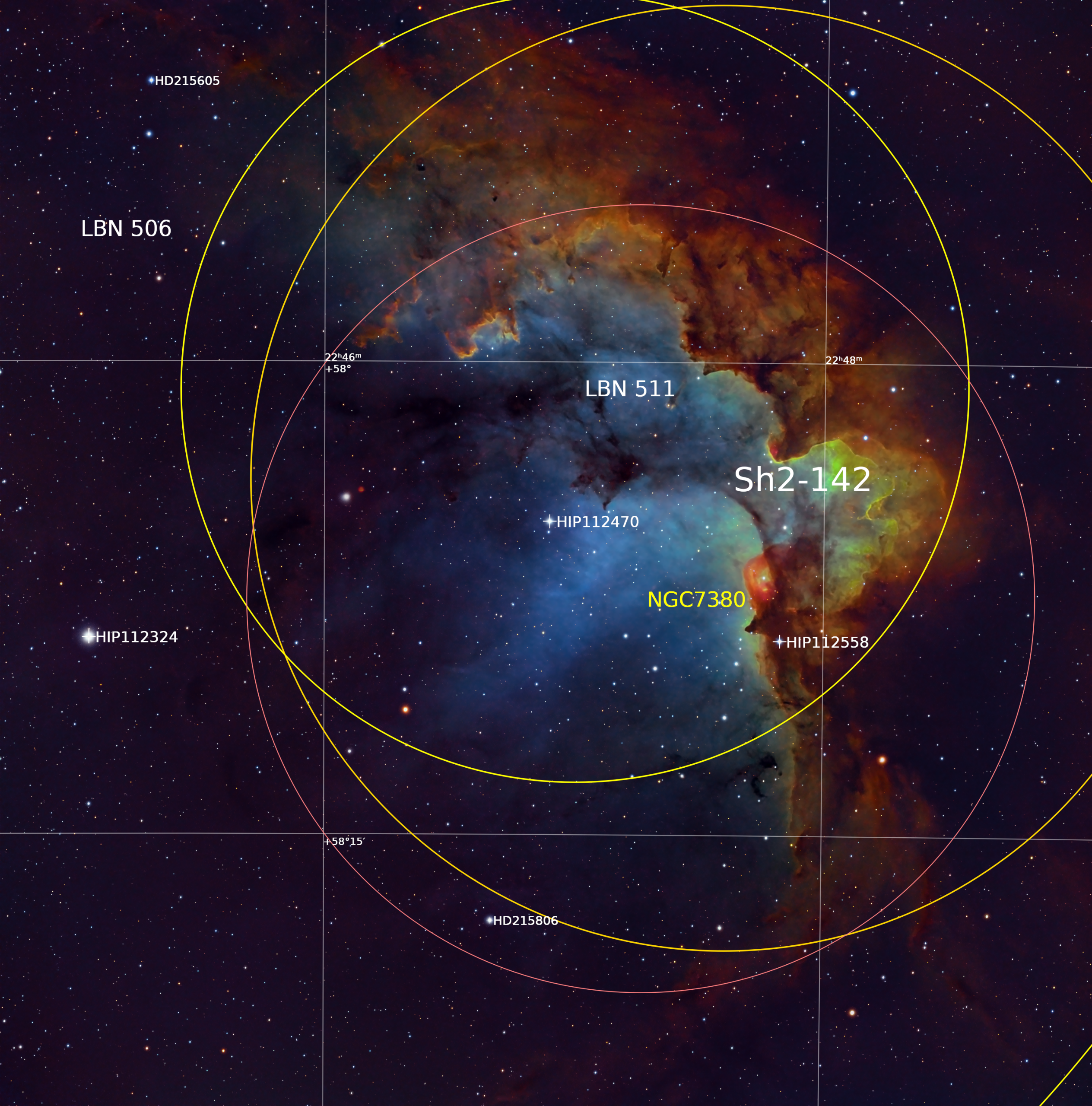
NGC 7380 Wizard Nebula
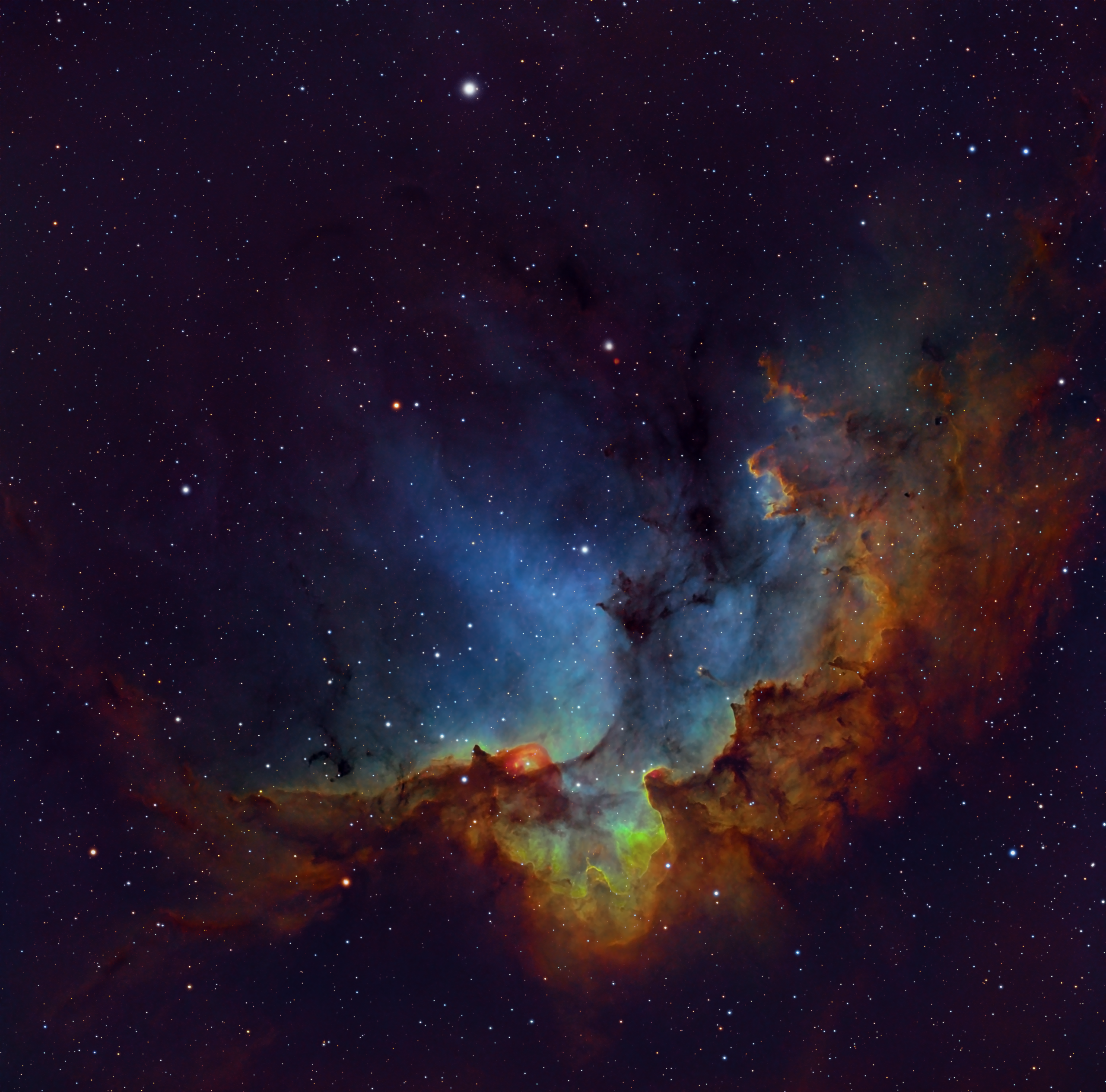
Overview of NGC 7380 (The Wizard Nebula)
The Wizard Nebula (cataloged as NGC 7380 along with the surrounding emission nebula Sh2-142) is a captivating young open star cluster embedded inside an active stellar nursery. Located approximately 7,200 to 8,500 light-years away in the northern constellation Cepheus, it is a favorite target for both professional astronomers studying star formation and amateur astrophotographers.
Key Characteristics & Structure
-
Constellation: Cepheus
-
Distance: ~7,200 – 8,500 light-years from Earth
-
Components: An open star cluster (NGC 7380) surrounded by a glowing H II emission region (Sh2-142)
-
Cluster Age: Very young, estimated between 4 to 12 million years old
-
Apparent Size: Spans roughly 25 arcminutes (nearly the size of a full moon)
Discovery and Naming
-
Discovery: The open cluster was discovered in 1787 by the pioneering astronomer Caroline Herschel. Her brother, William Herschel, later cataloged it. The surrounding gas cloud was later included in Stewart Sharpless’s 1959 catalog as Sh2-142.
-
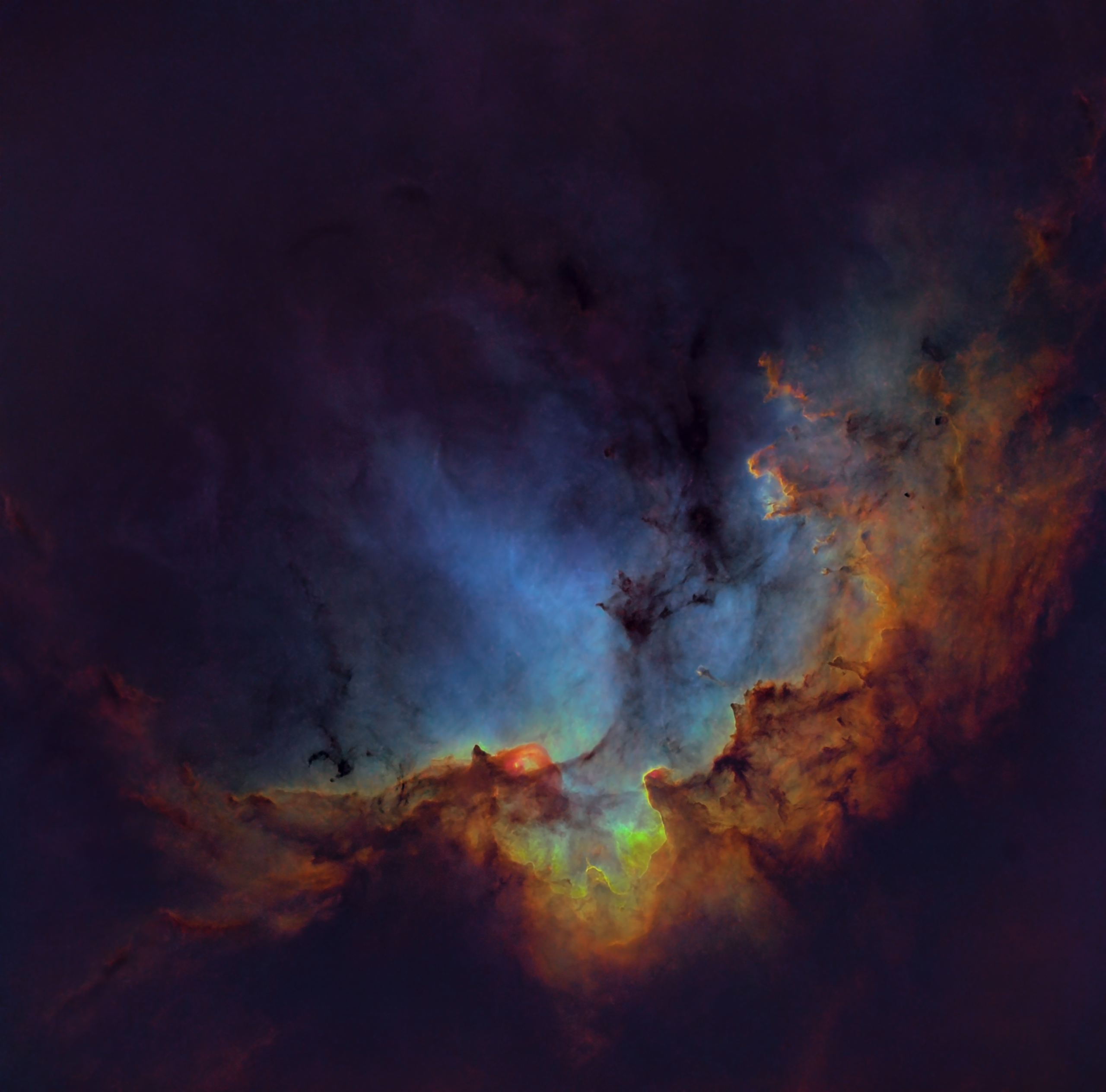
The “Wizard” Moniker: The evocative nickname comes from deep-exposure images where intricate dust lanes and glowing gas clouds twist into a shape resembling a medieval wizard wearing a pointed hat and flowing robes.
Stellar Nursery Dynamics
The Wizard Nebula is far from a quiet cloud of gas; it is an energetic factory of stellar birth:
-
Massive Ionizing Stars: At the heart of the cluster lies DH Cephei, a massive double-lined spectroscopic binary system consisting of O-type stars. The powerful ultraviolet radiation and stellar winds from these massive stars carve out pillars, cavities, and sculpted ridges in the surrounding gas.
-
Pre-Main Sequence Stars: Infrared and X-ray observations have uncovered dozens of pre-main sequence variable stars developing within the dust pillars, proving that star formation has been active relatively recently in cosmic terms.
-
Temporary Beauty: Because the massive ionizing stars quickly consume or blow away their natal gas, the nebula is a transient cosmic feature that will largely dissipate and fade away within a few million years.
Observing and Astrophotography
-
Visual Observation: Visually tracking down NGC 7380 can be quite difficult. While the embedded star cluster has a combined magnitude of about 7.2, the surrounding nebula has a low surface brightness, requiring dark skies, large apertures, and specialized filters (like an O-III or Hydrogen-alpha filter).
-
Astrophotography: It is exceptionally popular for narrowband imaging (using Hydrogen-alpha, Oxygen-III, and Sulfur-II filters). Long exposures easily reveal the dramatic contrasting dark dust lanes and bright emission arcs that give the nebula its magical appearance.
Acquisition details
Equipment
Telescope : Askar 151phq
Mount : Skywatcher EQ8r Pro
Camera : ZWO 533mm
Filters : Anitlia 3 Nm filters Ha, Oiii, Sii
Dates : 29/07/2026 – 10/08/2026
Frames : Exp 300, Ha*56. Oiii*47, Sii*25
Total Time : 10Hrs 40 Minutes