SH2-112 Nebula
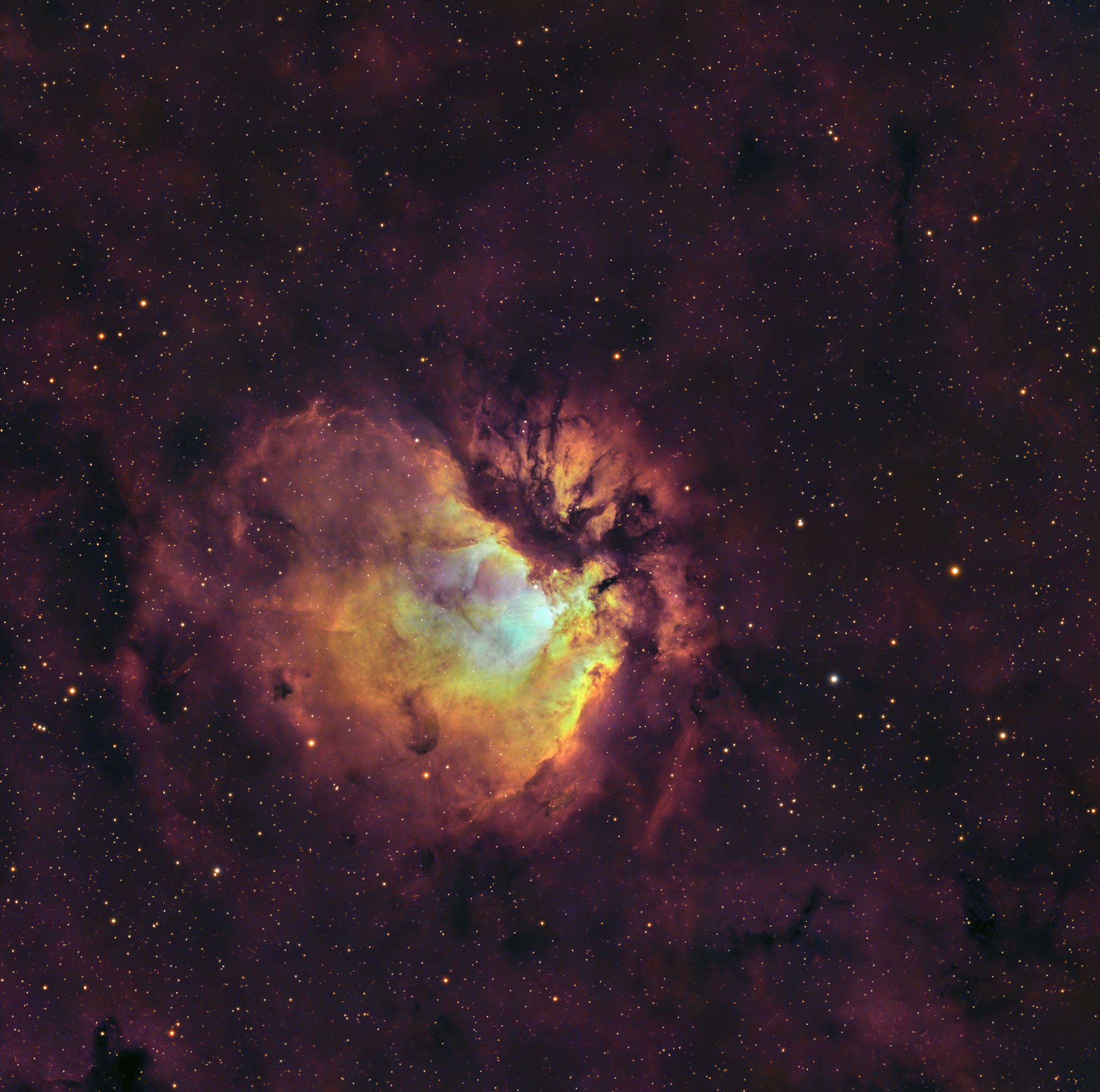
Sh2-112: A Stellar Nursery in Cygnus
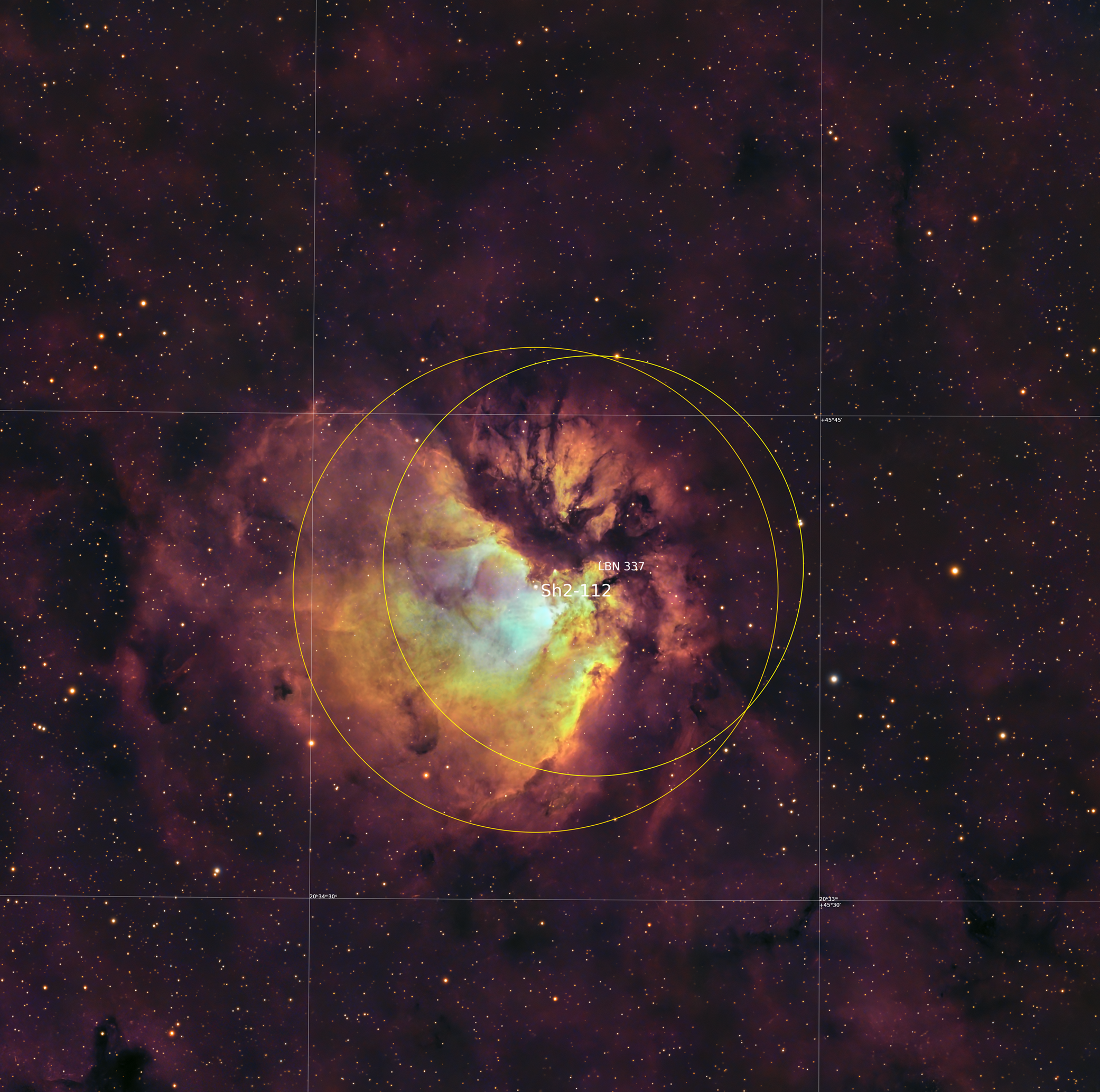
Sh2-112, also catalogued as LBN 337, is a striking emission nebula located in the constellation Cygnus, the Swan. Although it is less famous than some of Cygnus’s better-known nebulae, Sh2-112 is an impressive example of an H II region, a vast cloud of interstellar gas whose hydrogen is being energised by radiation from hot, massive stars.
Location and scale
Sh2-112 lies in the Orion Arm of the Milky Way, in the same broad region of the sky as the enormous Cygnus X star-forming complex. A commonly cited distance is approximately 5,600 light-years, or about 1,740 parsecs, although published estimates vary. At that distance, the nebula’s apparent size of roughly 15 arcminutes corresponds to a substantial physical region of space.
What makes the nebula glow?
The dominant source illuminating Sh2-112 is BD+45 3216, a very hot, massive O-type star situated towards the centre of the nebula. One catalogue identifies it more specifically as an O8V-class star.
Such a star emits an enormous amount of energetic ultraviolet radiation. This radiation ionises the surrounding hydrogen gas, producing the characteristic emission associated with an H II region. Astrophotographers therefore commonly image Sh2-112 using narrowband filters sensitive to hydrogen-alpha (Hα), ionised oxygen ([O III]) and ionised sulphur ([S II]) emission
A region where new stars are forming
Perhaps the most interesting aspect of Sh2-112 is that it is not simply a beautiful cloud of glowing gas. It is an active star-forming region. Research catalogues have identified 138 candidate young stellar objects within the nebula, with an average age of roughly one million years.
These very young objects give astronomers an opportunity to study how stars develop inside the gas and dust of their parent molecular clouds. Consequently, Sh2-112 provides a snapshot of the continuing cycle of stellar evolution in the Milky Way: gas and dust collapse to produce new stars, while radiation from the most massive newborn stars begins to reshape and disperse the remaining material.
Gas, dust and structure
Visually, Sh2-112 is notable for the contrast between its glowing emission and dark lanes of obscuring dust, particularly towards its western side.
These dark regions are clouds of material lying in front of brighter emission. In narrowband astrophotography, the combination of bright ionised gas and dark dust can give Sh2-112 a particularly dramatic appearance. Images combining Hα, [O III] and [S II] data can also reveal structures that are much less obvious in ordinary visible-light photographs.
Why Sh2-112 is interesting
Sh2-112 is a good example of how some relatively obscure deep-sky objects can be scientifically fascinating. It combines several important features in one area: a powerful O-type star, ionised hydrogen, dense obscuring dust and a population of very young stars. Together, they show how massive stars interact with the material from which they were born.
For astrophotographers, those same characteristics make Sh2-112 an attractive narrowband target. For astronomers, however, it represents something more fundamental: an active stellar nursery in which we can observe the relationship between newly formed stars and the interstellar environment surrounding them.
Acquisition details
Equipment
Telescope : Askar 151phq
Mount : Skywatcher EQ8r Pro
Camera : ZWO 533mm
Filters : Anitlia 3 Nm filters Ha, Oiii, Sii
Dates : 29/07/2026 – 21/09/2026
Frames : Exp 300, Ha*60. Oiii*64, Sii*45
Total Time : 14Hrs 35 Minutes