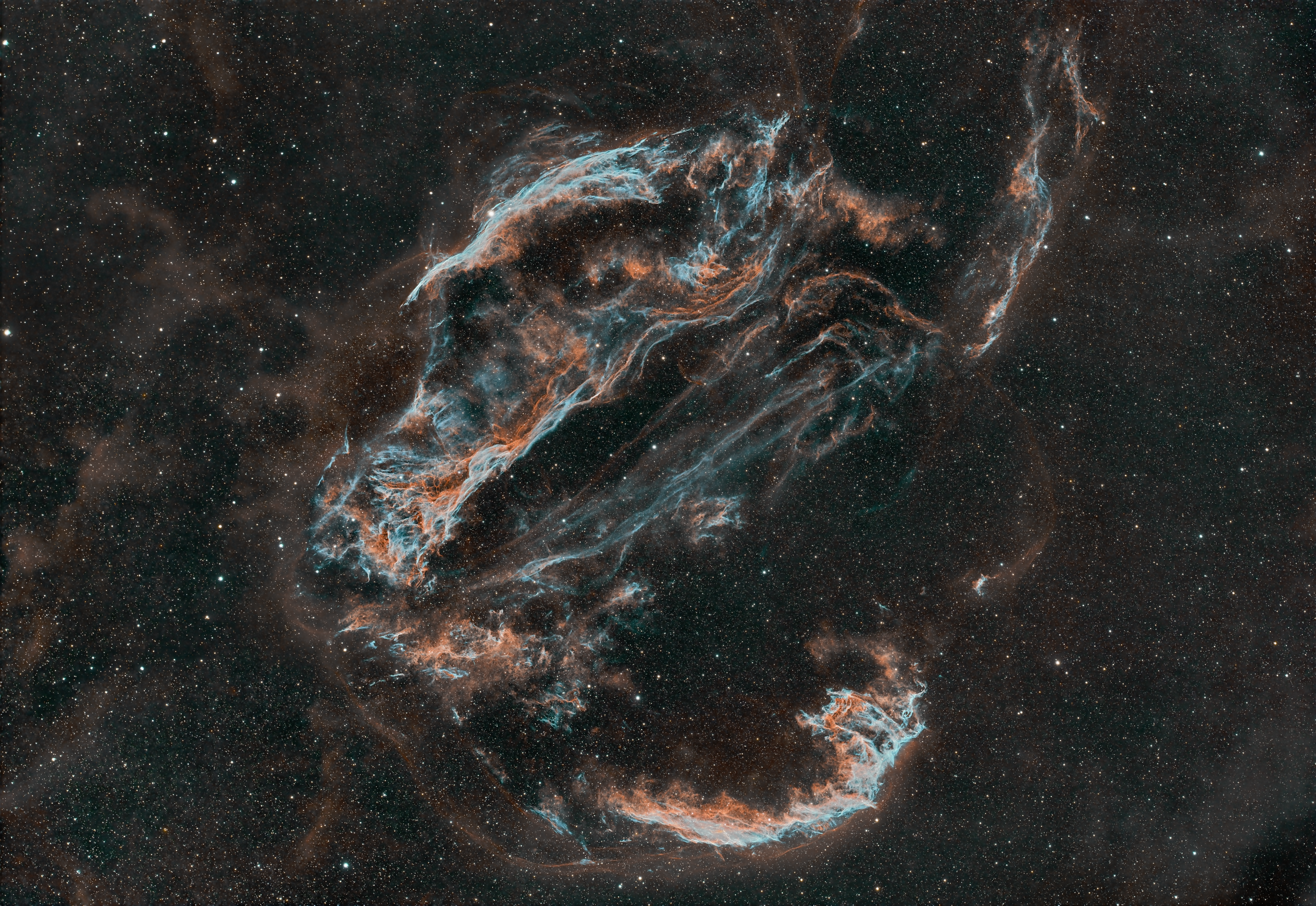
The Veil Nebula is a cloud of heated and ionized gas and dust in the constellation Cygnus.
It constitutes the brightest parts of the visible portion of the Cygnus Loop, a supernova remnant, many portions of which have acquired their own individual names and catalogue identifiers. The source supernova was a star 20 times more massive than the Sun which exploded between 10,000 and 20,000 years ago.At the time of the explosion, the supernova would have appeared brighter than Venus in the sky, and visible in the daytime.The remnants have since expanded to cover an area of the sky roughly 3 degrees in diameter (about 6 times the diameter, and 36 times the area, of the full Moon). While previous distance estimates have ranged from 1,200 to 5,800 light-years, a 2018 determination of 2,400 light-years is based on direct astrometric measurements.(The distance estimates affect also the estimates of size and age.)
The Hubble Space Telescope captured several images of the nebula. The analysis of the emissions from the nebula indicates the presence of oxygen, sulfur, and hydrogen. The Cygnus Loop is also a strong emitter of radio waves and x-rays.
Components
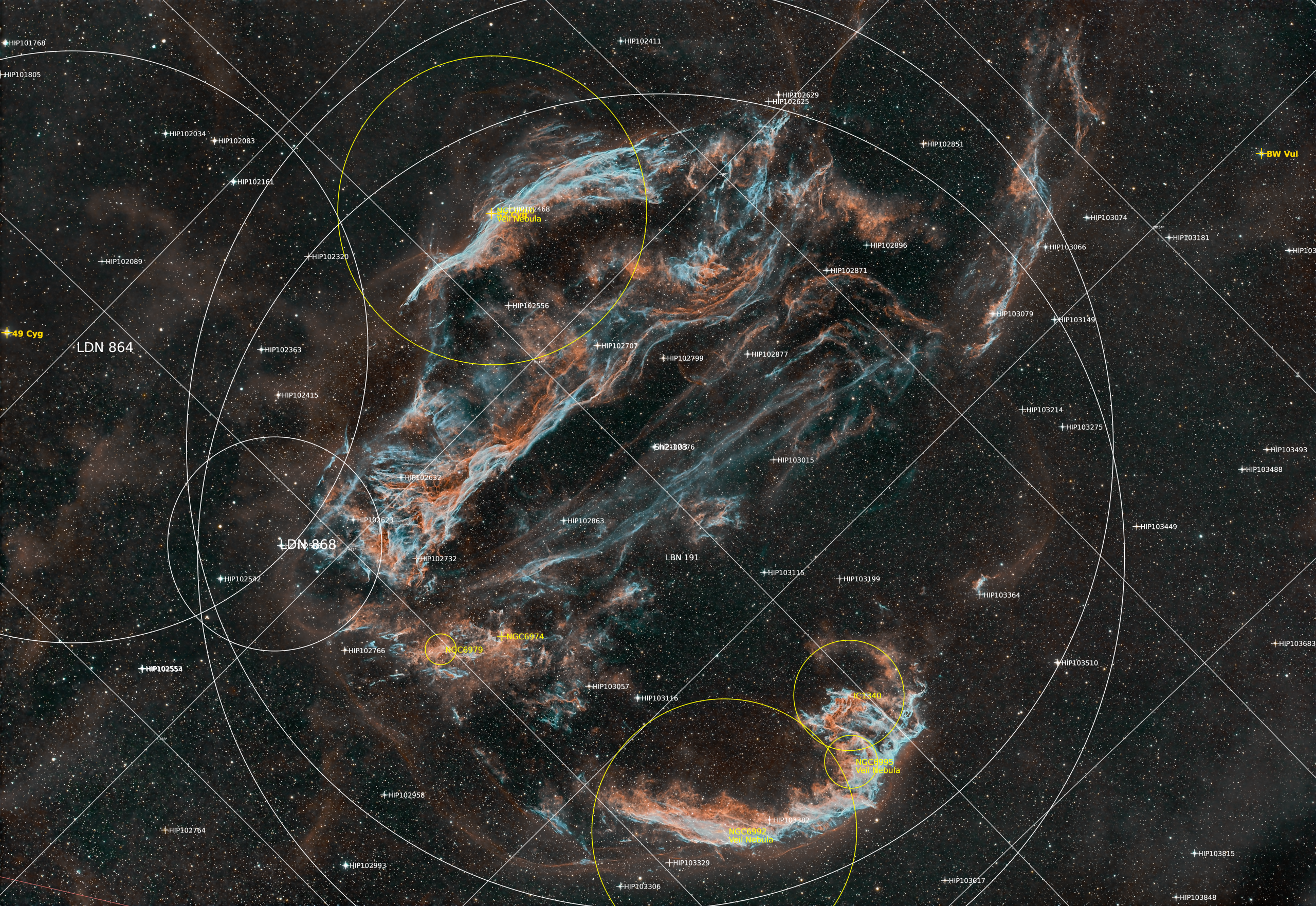

Similar view as above, showing the Cygnus Loop in optical emission lines as seen by the Northern Sky Narrowband Survey.
In modern usage, the names Veil Nebula, Cirrus Nebula, and Filamentary Nebula generally refer to the brightest part of the visible structure of the remnant, or even to the entire loop itself. The structure is so large that several NGC numbers were assigned to various arcs of the nebula.[ There are three main visual components:
- The Western Veil (also known as Caldwell 34), consisting of NGC 6960 (the “Witch’s Broom”, Lacework Nebula, “Filamentary Nebula”]) near the foreground star 52 Cygni;
- The Eastern Veil (also known as Caldwell 33), whose brightest area is NGC 6992, trailing off farther south into NGC 6995 (together with NGC 6992 also known as “Network Nebula) and IC 1340;
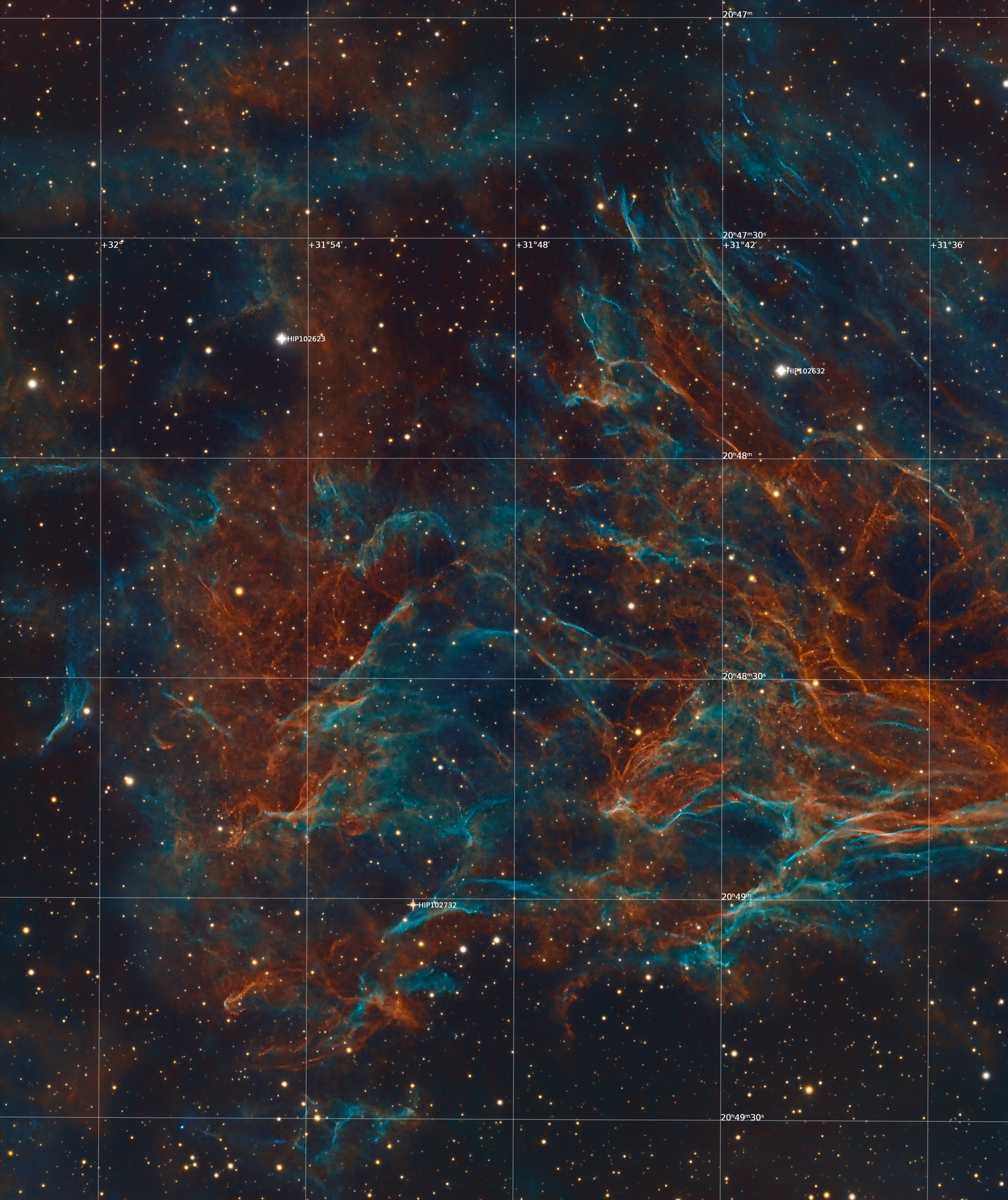
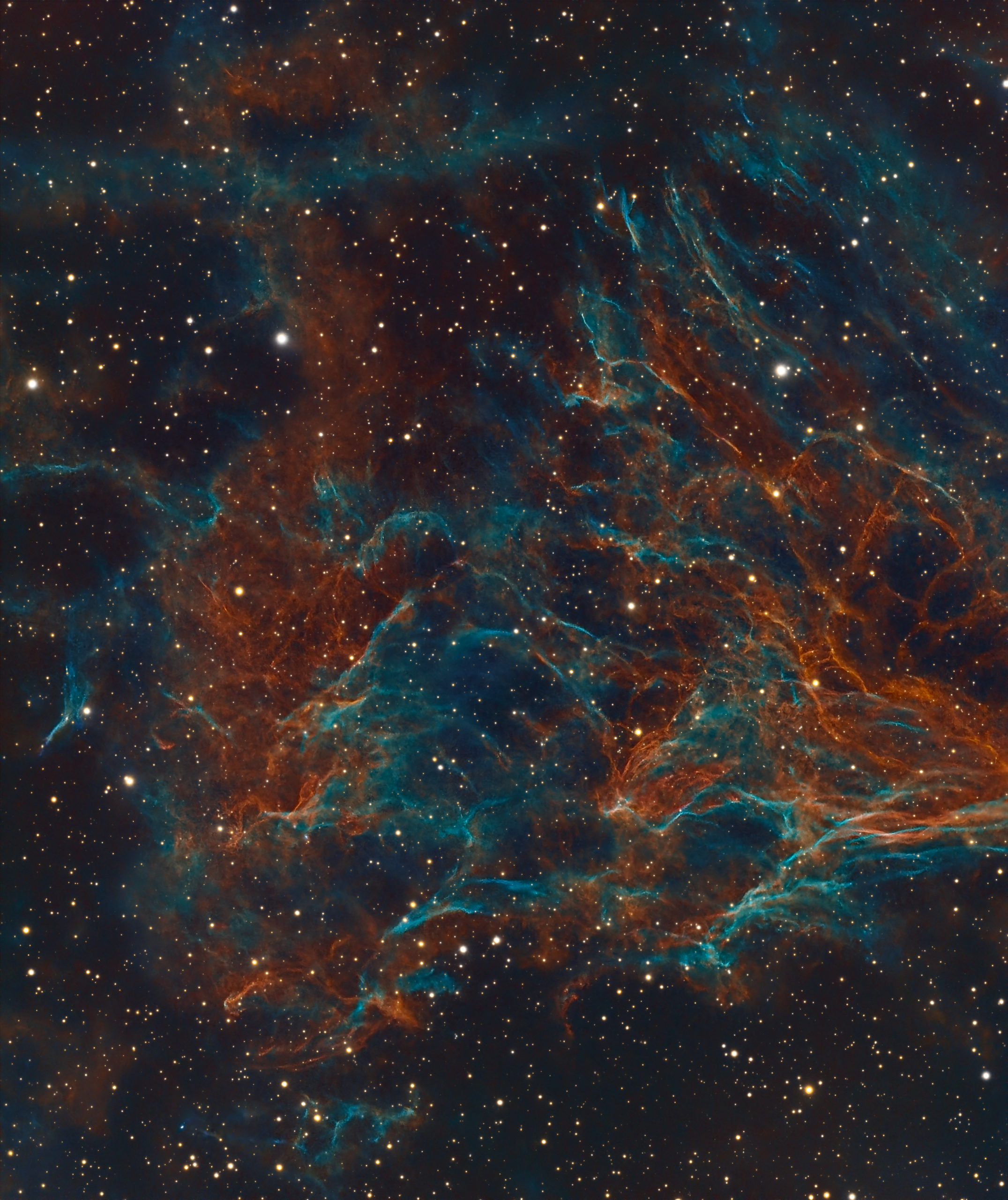
Pickering’s Triangle (or NGC 6974 and NGC 6979 are luminous knots in a fainter patch of nebulosity on the northern rim between NGC 6992 and Pickering’s Triangle.
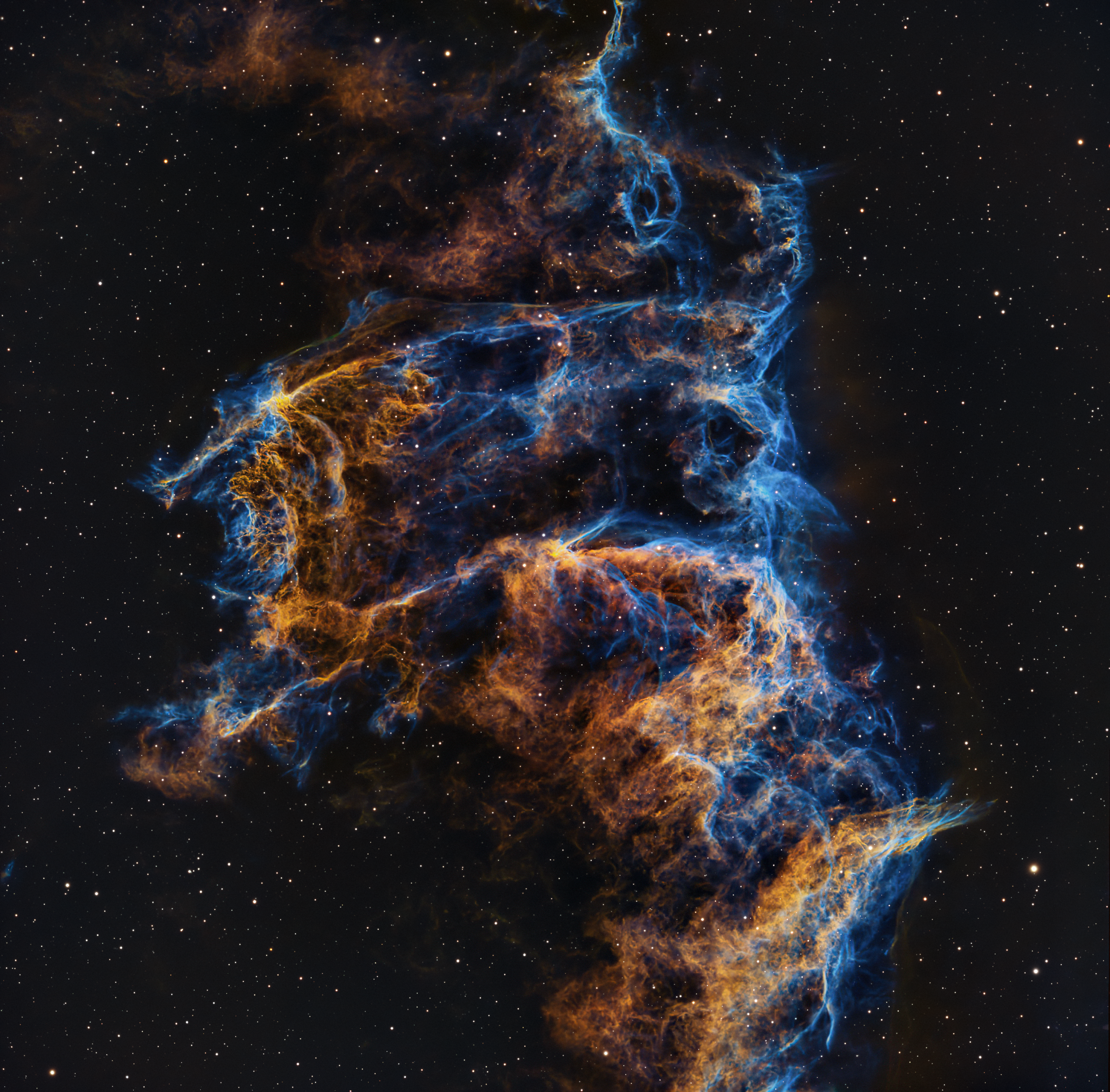
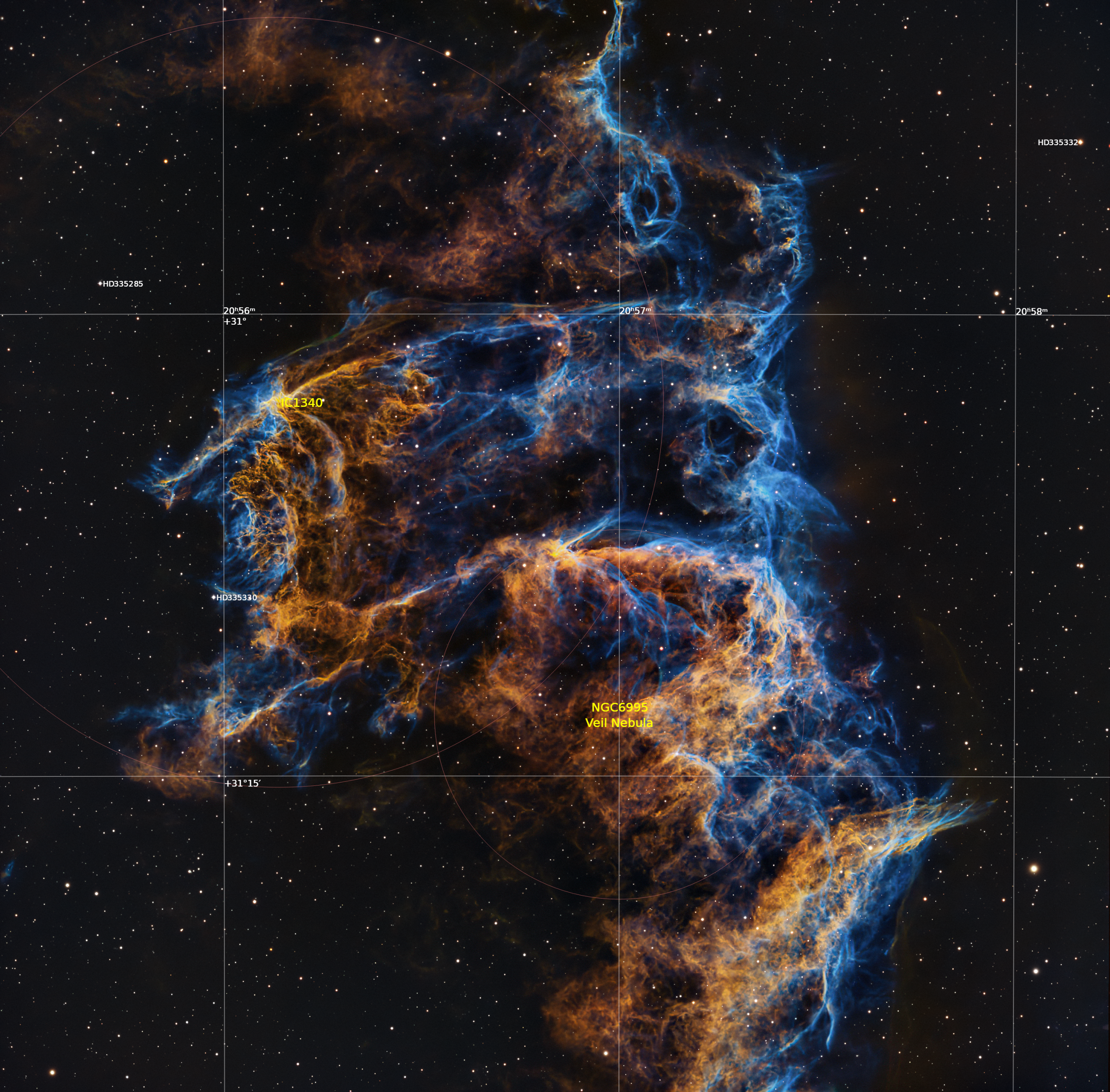
Below Image. NGC 6995 is a bright emission nebula that forms part of the eastern section of the Veil Nebula, the remains of a massive star that exploded in a supernova around 10,000 years ago. Located in the constellation Cygnus, NGC 6995 is approximately 2,400 light-years from Earth. Its delicate, filament-like structures are created by shock waves from the supernova interacting with surrounding interstellar gas, making it one of the most striking examples of a supernova remnant in the night sky.
Acquisition details
Equipment
- Imaging Telescopes Or Lenses
- Askar 151PHQ
- Imaging Cameras
- ZWO ASI533MM Pro
- Mounts
- Skywatcher eq8r pro
- Filters
- Software
- Adobe Photoshop · Pleiades Astrophoto PixInsight
- Dates:
-
- Frames:
-