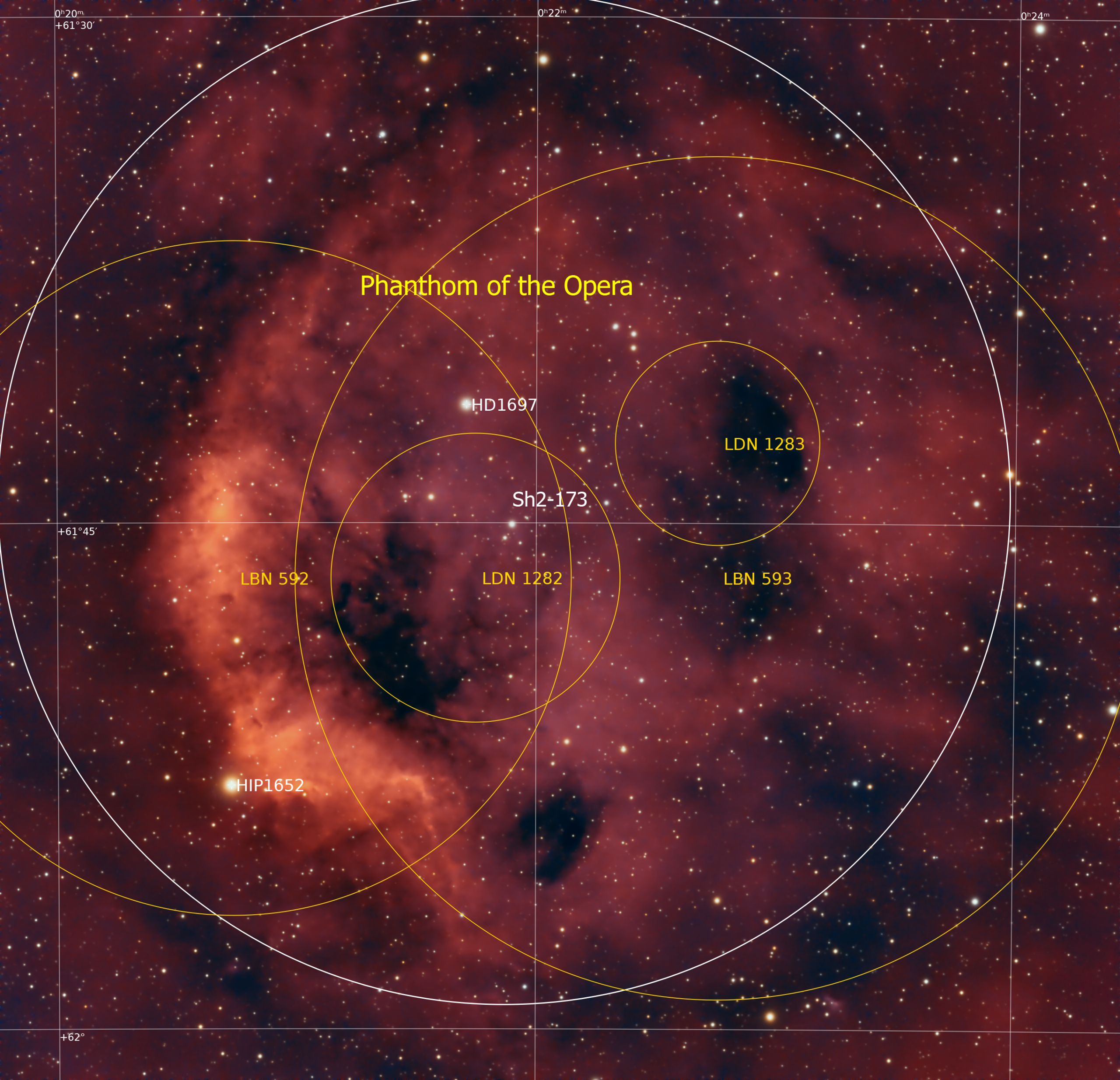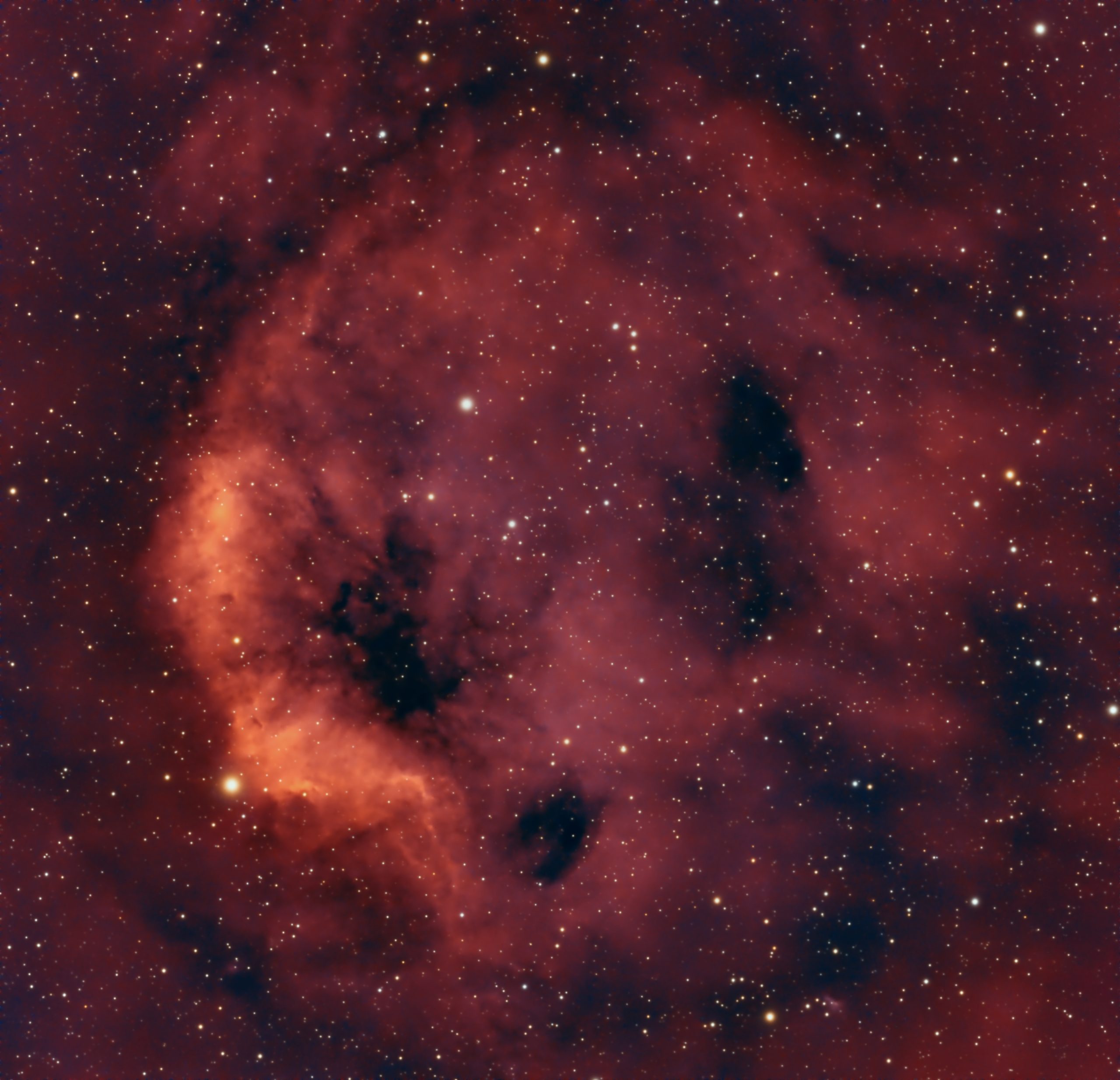
Sh2-173 (also designated as LBN 593 or Simeis 21) is a striking but exceptionally faint cosmic H II emission nebula located roughly 8,200 to 8,800 light-years away from Earth. It resides within the Perseus spiral arm of our Milky Way Galaxy, positioned in the northern constellation of Cassiopeia, just a few degrees north of the star Caph.
The Cosmic Mask
The nebula spans approximately 77 light-years across. It is famously known by its popular nickname, the Phantom of the Opera Nebula, due to a distinct visual illusion. When imaged, its bright, curving ionized gas rims juxtaposed with dense, foreground dark dust lanes (such as LDN 1282 and LDN 1283).
Astrophotography Framing and Challenges
For amateur astrophotographers, Sh2-173 is notoriously challenging due to its low surface brightness. Capturing the finer, wispy hydrogen structures extending into the background requires significant integration times, often pushing upwards of 15 to 30+ hours of exposure.
Narrowband Imaging (SHO): It is a prime candidate for sulfur, hydrogen, and oxygen filters. While H-alpha yields a roaring response along the phantom’s “mask” profile, the OIII emission is exceptionally weak and requires long, deep exposures to extract.
Surrounding Gems: When shooting a wider field of view, the composition is heavily enriched by the nearby open star cluster NGC 103, the blue-tinted planetary nebula OU 2 (discovered by Nicolas Outters in 2010), and the variable star 12 Cas.
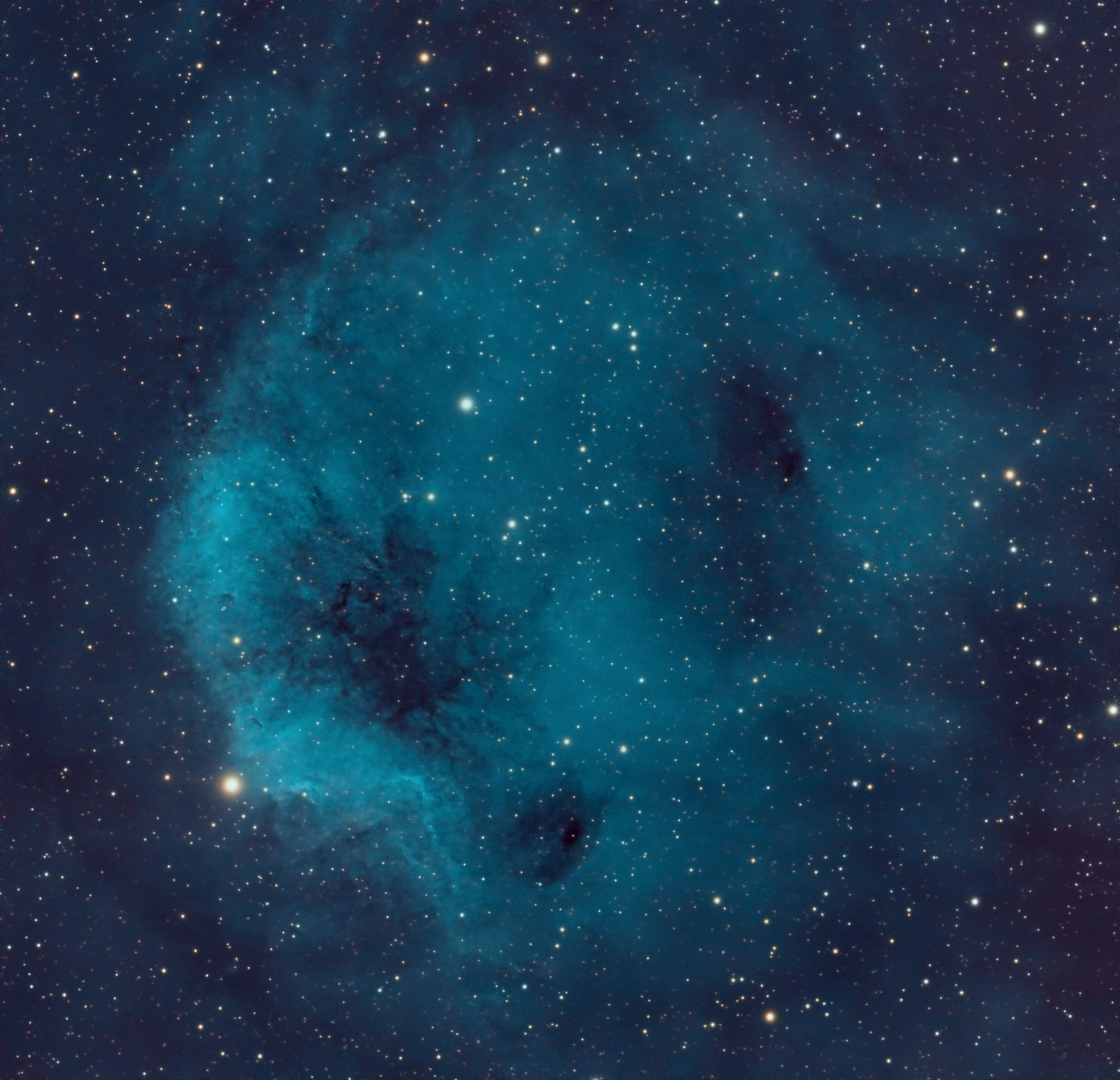
Below is a version of this image in HOO as opposed to the traditional SHO.
Acquisition details
Equipment
Telescope : Askar 151Phq
Mount : Skywatcher EQ8r Pro
Camera : ZWO 533mm pro
Filters : Ha, Oiii, Sii
Dates : 08/07/2026 – 07/07/2026
Frames : Ha 44*300, Oiii 29*300, Sii 33*300
Total Time : 8hrs 50Minutes