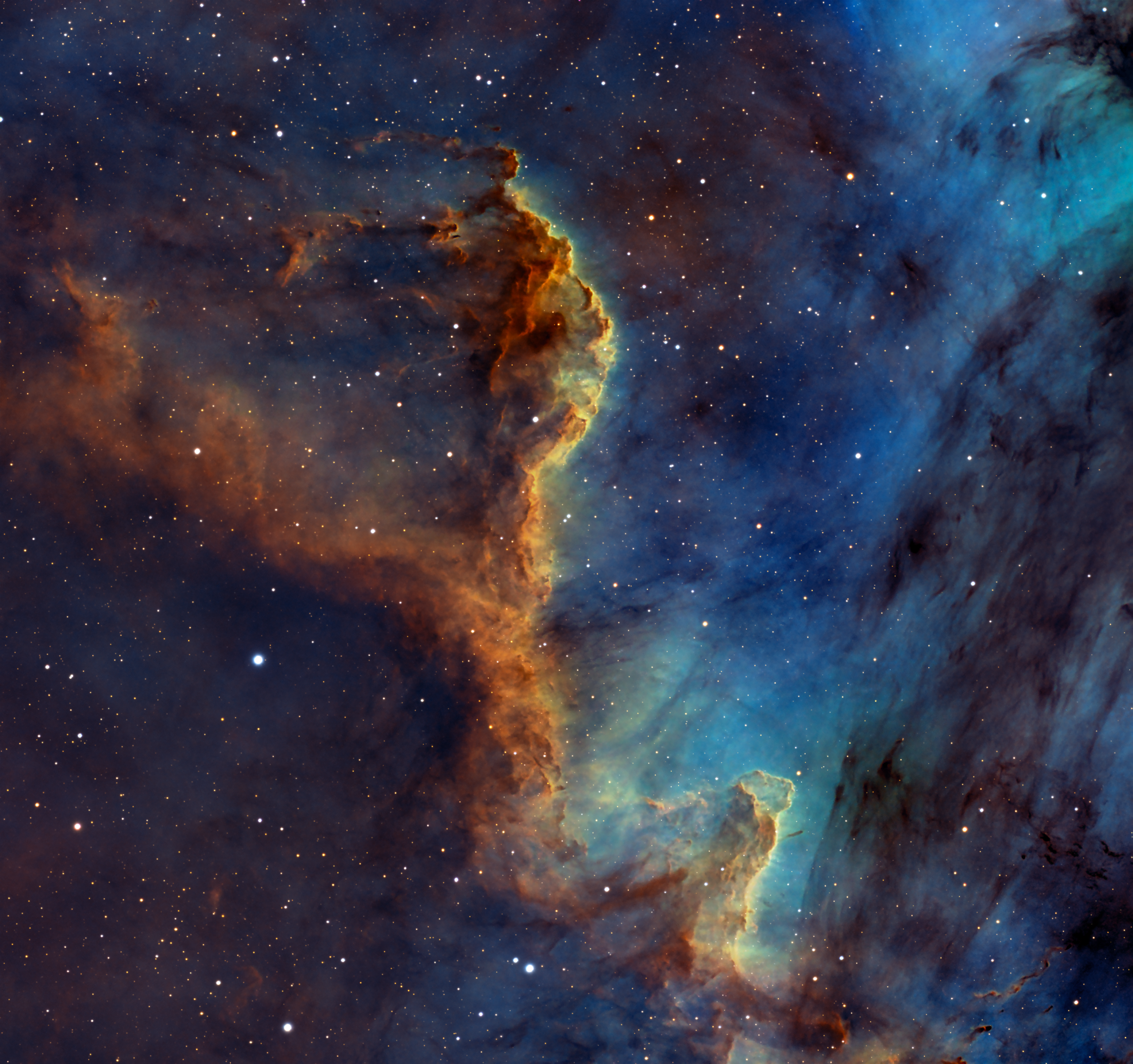
 Sculpting Cosmic Continents: The Cygnus Wall of NGC 7000 Detail LBN 354
The Cygnus Wall is one of the most visually stunning and scientifically intriguing features within the North America Nebula (NGC 7000), located roughly 2,500 light-years away in the constellation Cygnus. Often compared to the Rio Grande and Central American region of its terrestrial namesake, this dramatic structure serves as a prime example of stellar nurseries and the powerful interplay between massive stars and interstellar gas.
Structure and Composition
At its core, the Cygnus Wall is an ionization front—a dense ridge of gas and dust where intense ultraviolet radiation from hot, newly formed massive stars erodes and sculpts the surrounding molecular cloud.
-
Emission Glowing: The region glows brightly primarily in hydrogen-alpha light, showcasing the energetic ionization of hydrogen gas.
-
Dark Dust Lanes: Interspersed with the bright emission are thick, opaque lanes of cosmic dust that block background starlight, creating striking visual contrasts.
-
Active Star Formation: Deep within the dense pillars of the wall, gravitational collapse is actively triggering the birth of new protostars and young stellar objects (YSOs).
Astrophotographical Significance
For both professional astronomers and amateur astrophotographers, the Cygnus Wall is a premier target. Imagers frequently use narrowband filters—such as Hydrogen-alpha, Oxygen III, and Sulfur II—to map the intricate textures, gas flows, and shockwaves carved into the nebula. These detailed captures reveal complex tendrils of dust that resemble fiery brushstrokes across the night sky.
Quick Fact: The energy driving the brilliant glow of the Cygnus Wall comes from hot, massive stars hidden within or behind the nebula, which flood the region with high-energy ultraviolet radiation.
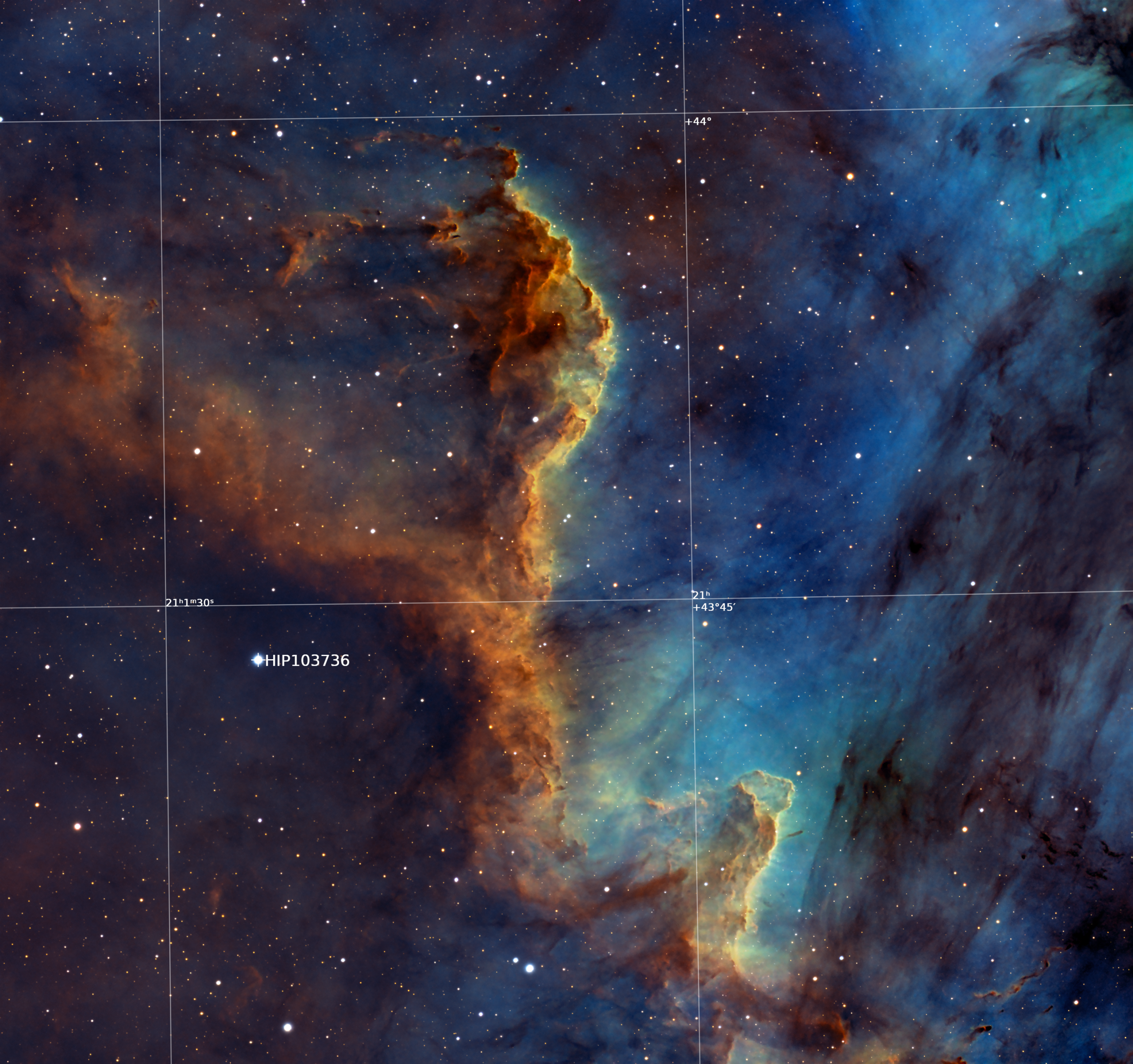
Acquisition details
Equipment
Telescope : William Optics 81 gt
Mount : Skywatcher EQ6r Pro
Camera : ZWO 6200mm
Filters : Anitlia 2.5 Nm Ultra filters Ha, Oiii, Sii
Dates : 18/06/202 – 23/09/2026
Frames : Exp 300, Ha*50. Oiii*60, Sii*40
Total Time : 12Hrs 30 Minutes