Information from Wikipedia
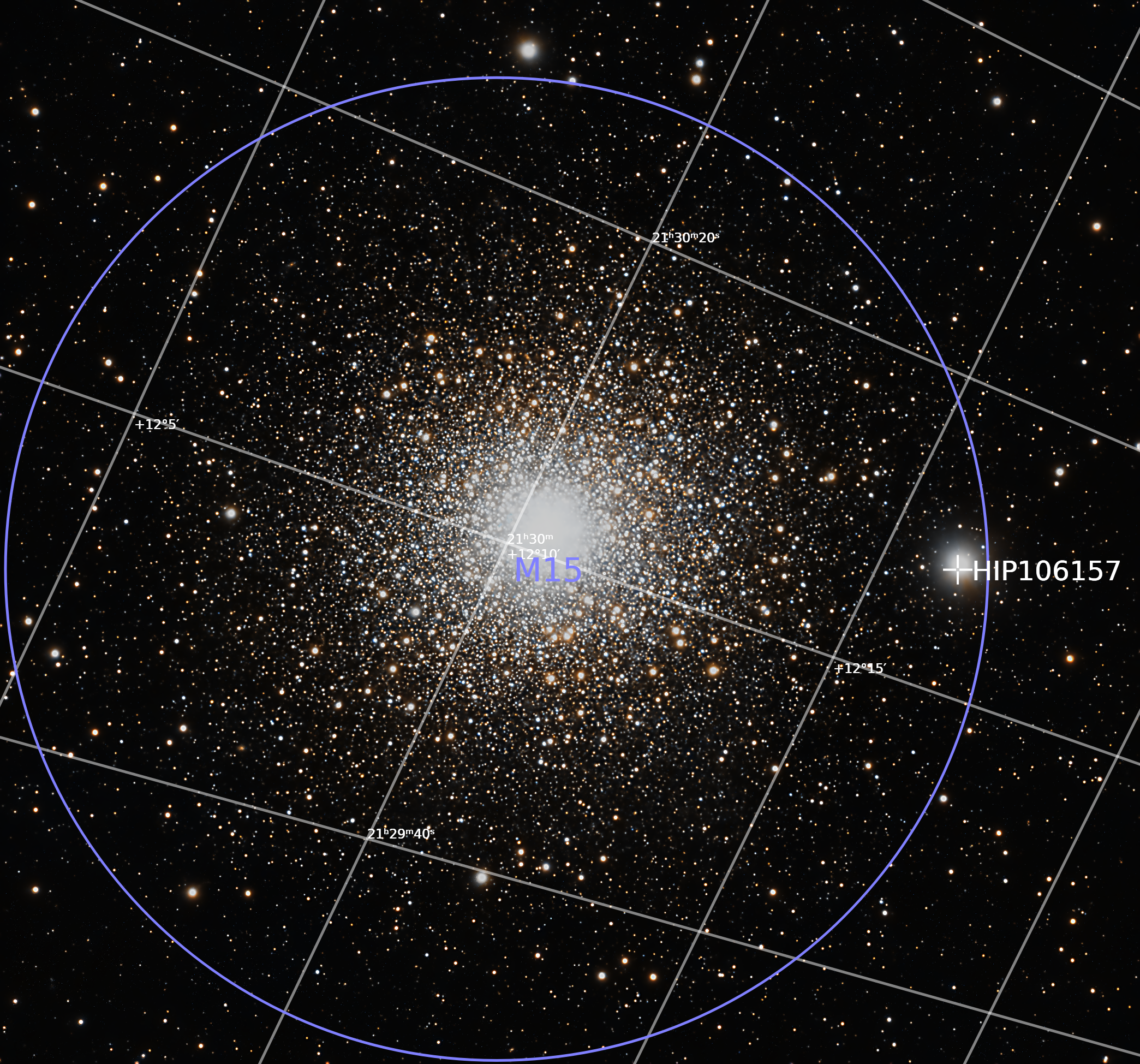
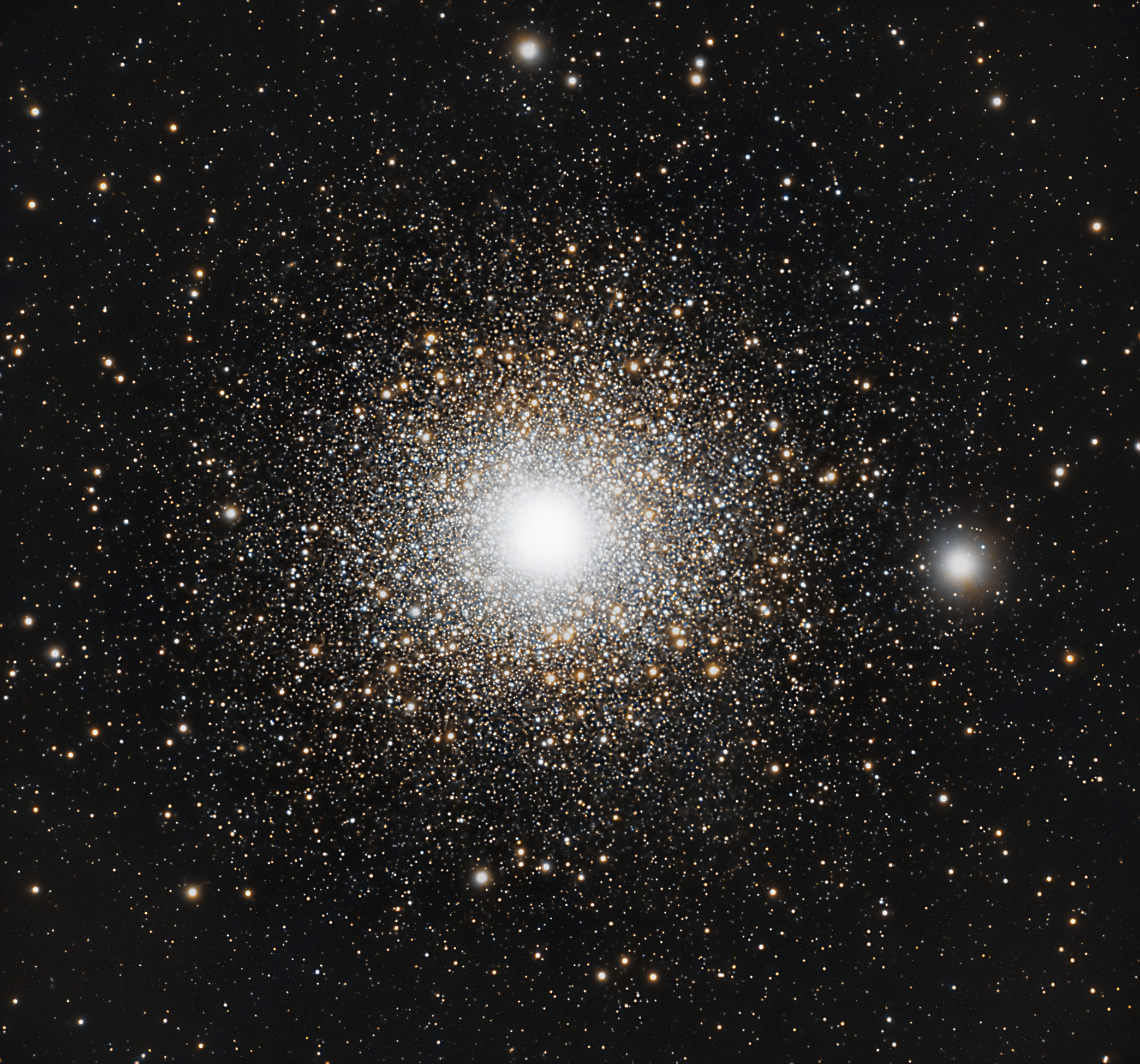
Messier 15 or M15 (also designated NGC 7078 and sometimes known as the Great Pegasus Cluster) is a globular cluster in the constellation Pegasus. It was discovered by Jean-Dominique Maraldi in 1746 and included in Charles Messier’s catalogue of comet-like objects in 1764. At an estimated 12.5±1.3 billion years old, it is one of the oldest known globular clusters.
M 15 is about 35,700 light-years from Earth, and 175 light-years in diameter. It has an absolute magnitude of −9.2, which translates to a total luminosity of 360,000 times that of the Sun. Messier 15 is one of the most densely packed globulars known in the Milky Way galaxy. Its core has undergone a contraction known as “core collapse” and it has a central density cusp with an enormous number of stars surrounding what may be a central black hole.
Home to over 100,000 stars,the cluster is notable for containing a large number of variable stars (112) and pulsars (8), including one double neutron star system, M15-C. It also contains Pease 1, the first planetary nebula discovered within a globular cluster in 1928. Just three others have been found in globular clusters since then.
Image Data
Telescope : Celestron 8HD Edge
Imaging Camera : ZWO ASI533mm pro
Filters :Antillia 4.5 R,G,B,L
Mount : Skywatcher EQ6r Pro
Exposure : 90s
Gain : 110
R=58 , G=36, B=47, L=115
Total Time : 6hrs 40mins
Date : June 2025