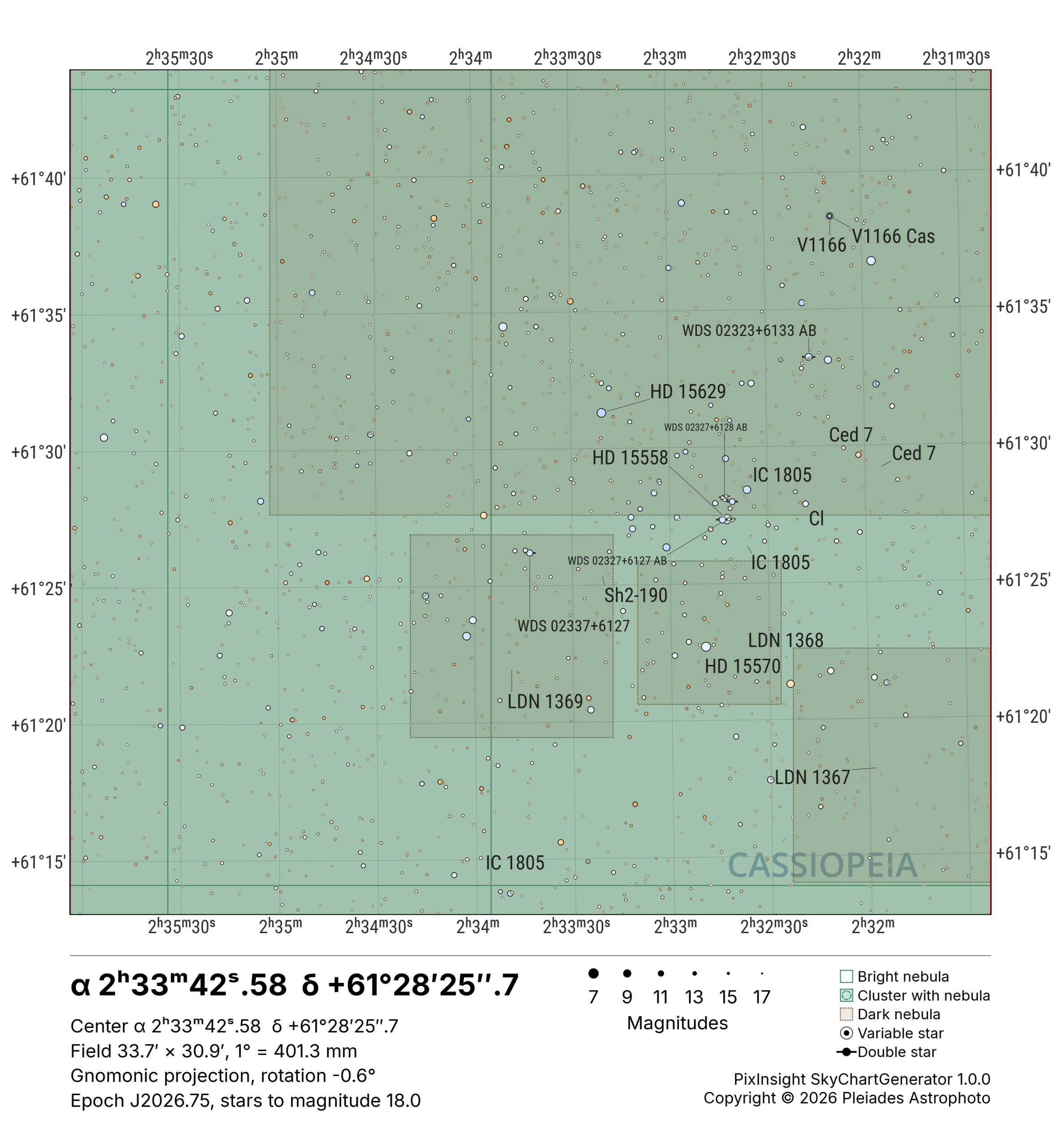
The Heart of Sh2-190
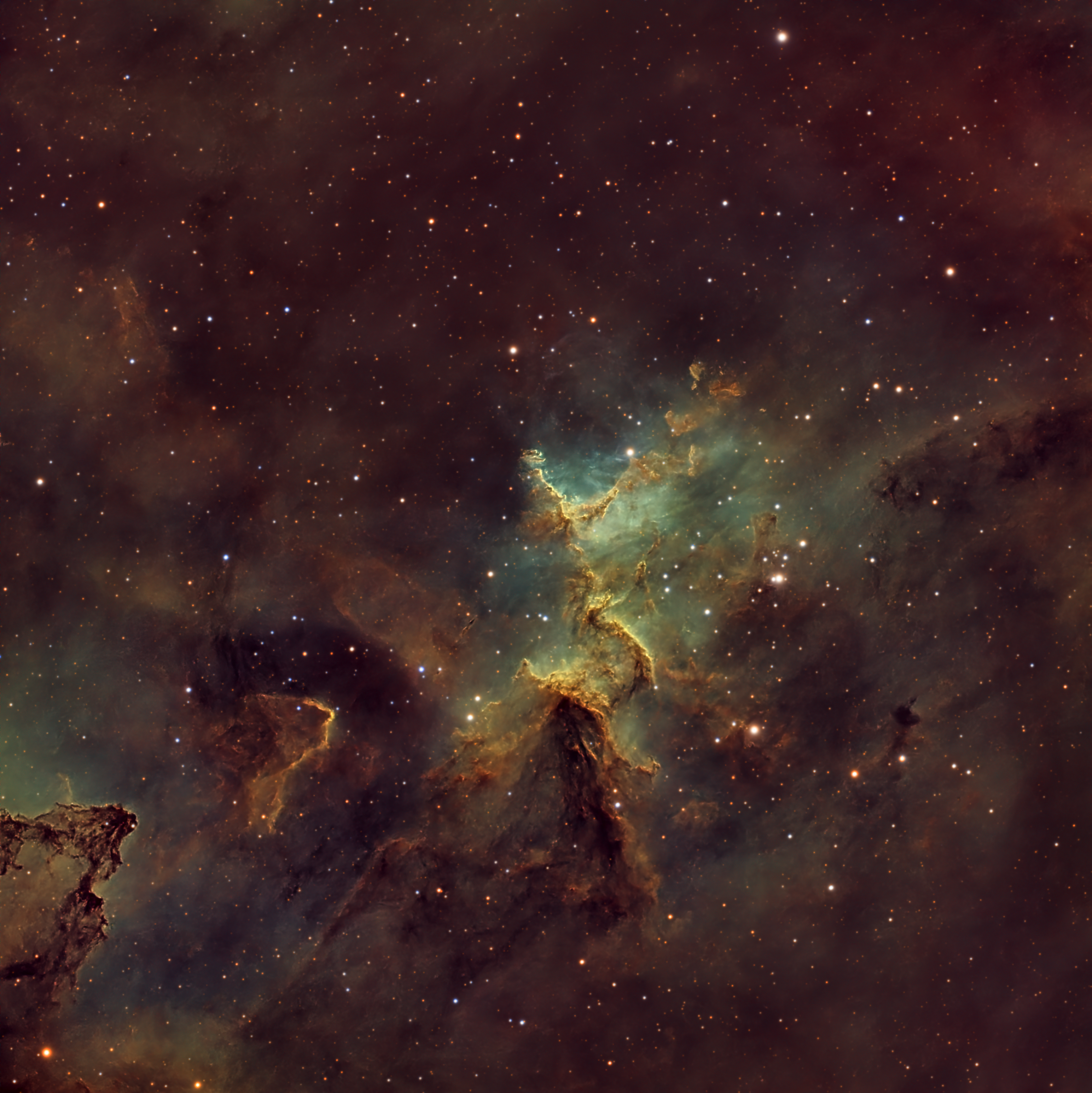
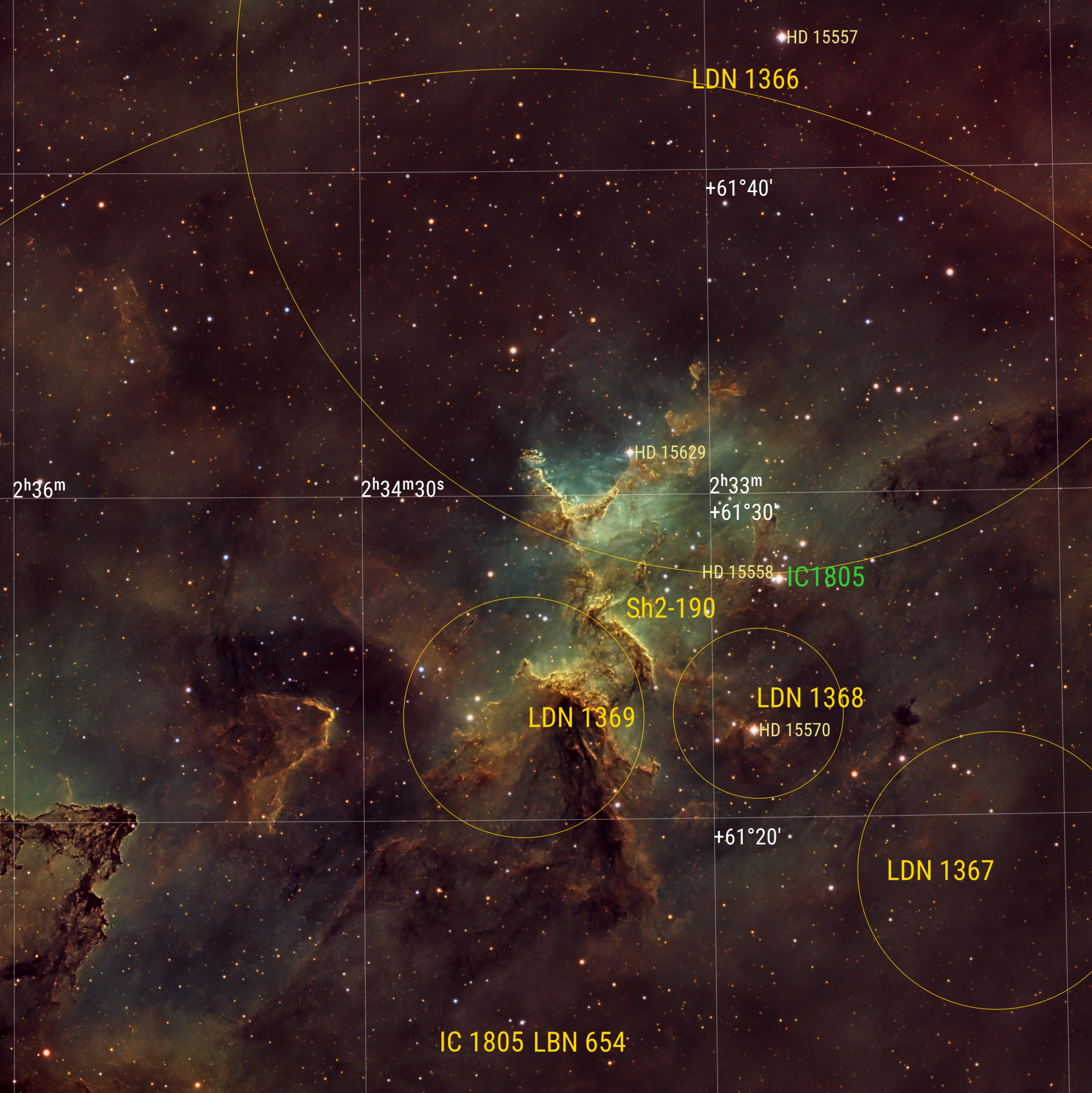
At the centre of the magnificent Heart Nebula lies Melotte 15, a young open star cluster embedded within the vast emission nebula Sh2-190, more commonly known as IC 1805 or the Heart Nebula. Located in the constellation Cassiopeia and roughly 7,000–7,500 light-years from Earth, this remarkable region lies within the Perseus Arm of the Milky Way.
Melotte 15 contains a population of young, hot and massive stars whose intense ultraviolet radiation energises the enormous surrounding clouds of interstellar gas. Some of the brightest stars in the cluster are extraordinarily massive, approaching around 50 times the mass of the Sun. Their powerful radiation plays a major role in shaping and illuminating the surrounding Heart Nebula.
The close-up region surrounding Melotte 15 is especially striking because it reveals what is happening deep inside an active star-forming environment. Rather than appearing as a smooth cloud of glowing gas, the nebula is filled with intricate ridges, cavities, filaments and towering structures of darker material.
These formations originate within the dense gas and dust from which the cluster formed. Radiation from the young stars ionises exposed material and gradually erodes the surrounding clouds. Denser concentrations resist this process for longer, leaving behind the dramatic pillars and sculpted structures visible across the region.
One of the most beautiful characteristics of Melotte 15 is the network of luminous rims tracing the boundaries of these darker clouds. These bright interfaces reveal locations where energetic radiation from the cluster encounters denser material. Against the more diffuse emission behind them, the illuminated edges give the nebula an extraordinary impression of depth and complexity.
Sh2-190 itself is an enormous H II region dominated by glowing ionised hydrogen, but narrowband imaging can also record emission associated with ionised oxygen and sulphur. When these wavelengths are combined using an SHO palette, the resulting colours provide strong separation between structures within the nebula. Golden and copper-toned ridges can contrast dramatically with cyan, turquoise and blue-green emission, while the densest obscuring material appears as deep brown or almost black structures.
Melotte 15 therefore provides a spectacular example of the relationship between young massive stars and the material from which they were born. The same stellar radiation that causes the surrounding nebula to glow is simultaneously transforming its environment, carving cavities and sculpting the remaining interstellar gas and dust.
This continual interaction between young stars, radiation, gas and dust has created the extraordinary landscape at the centre of Sh2-190, making Melotte 15 one of the most visually compelling regions of the Heart Nebula and an outstanding target for high-resolution narrowband astrophotography.
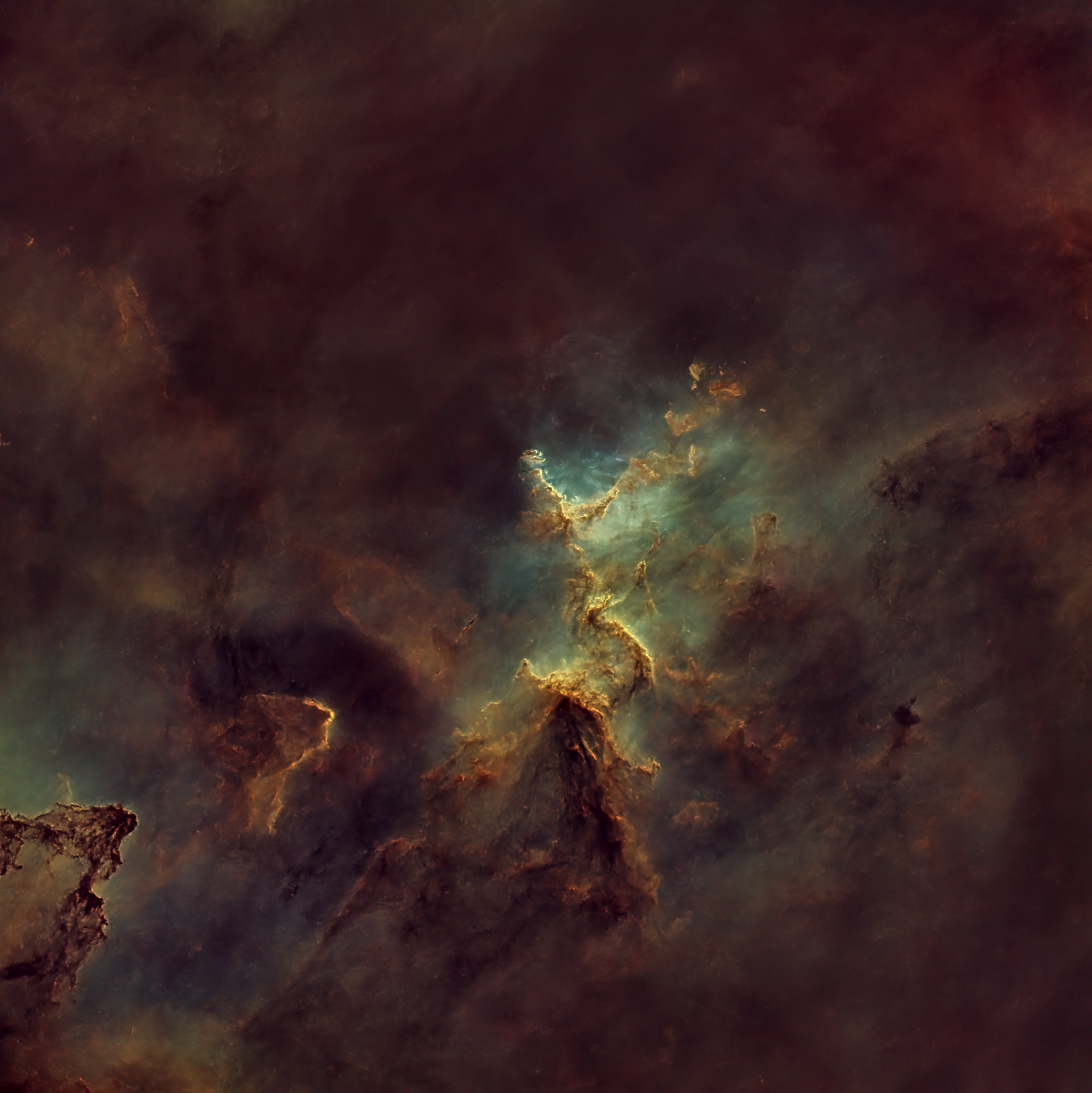
Below is the Image starless showing the detail that lies within.
Acquisition details
Equipment
Telescope : Askar 151Phq
Mount : Skywatcher EQ8r Pro
Camera : ZWO 533mm pro
Filters : Ha, Oiii, Sii
Dates : 23/10/2026 – 01/11/2026
Frames : Ha 78*180, Oiii 73*180, Sii 41*180
Total Time : 9hrs 36Minutes