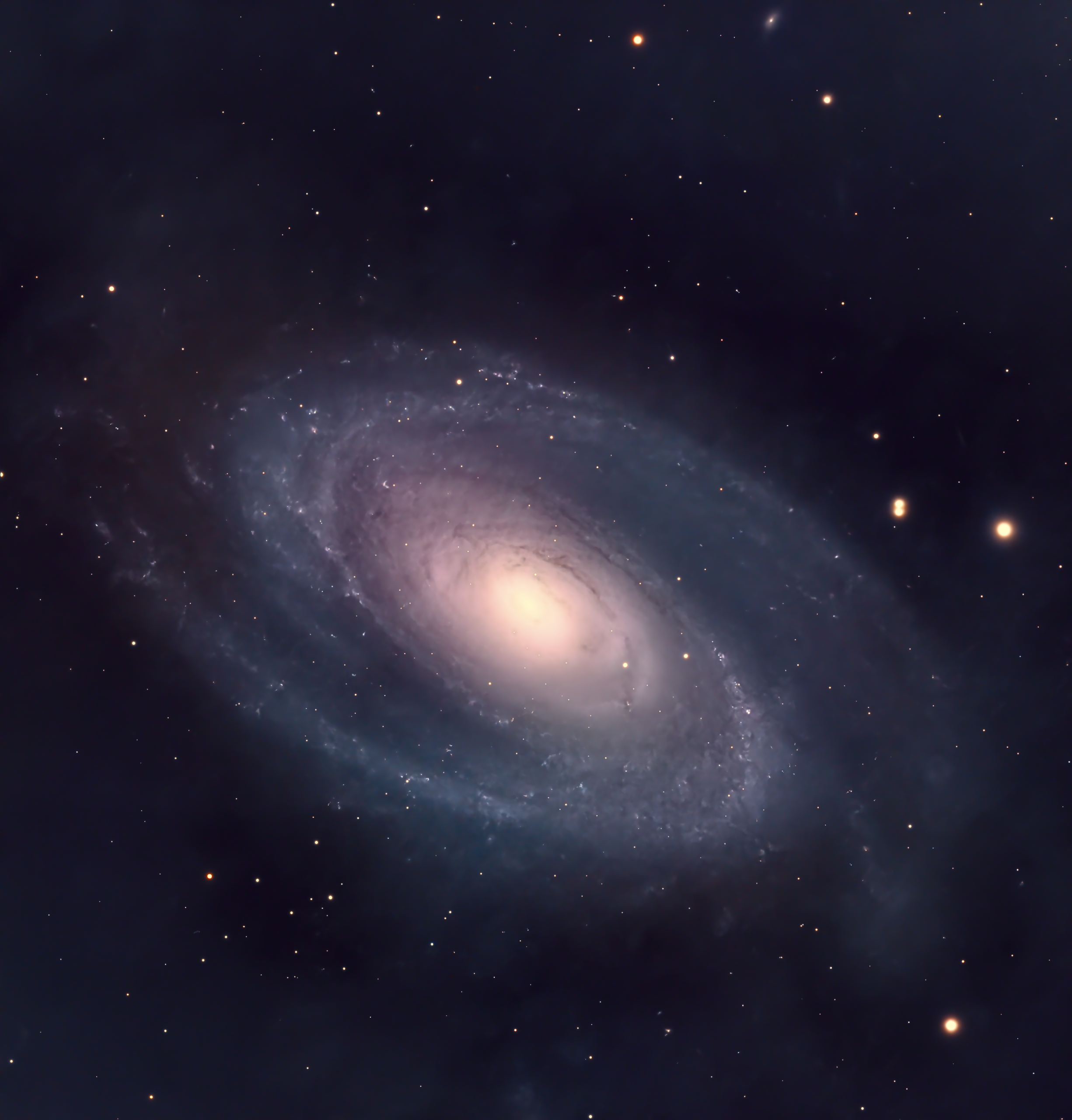
M81 Bodes Galaxy
M81, also known as Bode’s Galaxy, is a beautiful spiral galaxy located in the constellation Ursa Major. It is one of the most well-known galaxies in the night sky and has attracted the attention of astronomers for centuries. M81 is relatively close to the Milky Way, making it an important object for studying how galaxies form, evolve, and interact with one another.
M81 was discovered in 1774 by the German astronomer Johann Elert Bode, who also discovered its nearby companion galaxy, M82. M81 and M82 are separated by only about 150,000 light-years and are believed to have interacted gravitationally in the past. These interactions have influenced the structure and activity of both galaxies, making the pair particularly interesting to scientists.
M81 is a spiral galaxy, meaning that it has a central bulge surrounded by sweeping spiral arms. It is estimated to be about 12 million light-years away from Earth and contains hundreds of billions of stars. Its spiral arms contain large amounts of gas and dust, providing material from which new stars can form. At the centre of M81 lies a supermassive black hole, estimated to have a mass of around 70 million times that of the Sun.
One of the most interesting features of M81 is its relationship with M82. Their gravitational interaction has affected the distribution of gas and stars within the galaxies. M82, sometimes called the Cigar Galaxy, is particularly active and is undergoing a period of intense star formation. By studying M81 and M82 together, astronomers can learn more about the effects that close encounters between galaxies can have on their development.
M81 can be observed with a telescope and, under very dark skies, may even be detected with binoculars. Although it appears as a faint patch of light because of its enormous distance from Earth, photographs taken by modern telescopes reveal its magnificent spiral structure. Space telescopes and large ground-based observatories have provided detailed images and valuable information about its stars, gas, dust, and central black hole.
In conclusion, M81 is much more than a distant collection of stars. It is an important laboratory for understanding galaxies and the forces that shape them. Its proximity, beautiful spiral structure, and interaction with M82 make it one of the most fascinating galaxies for both professional astronomers and amateur stargazers. Studying M81 helps us understand not only distant galaxies but also the possible future and evolution of our own Milky Way.
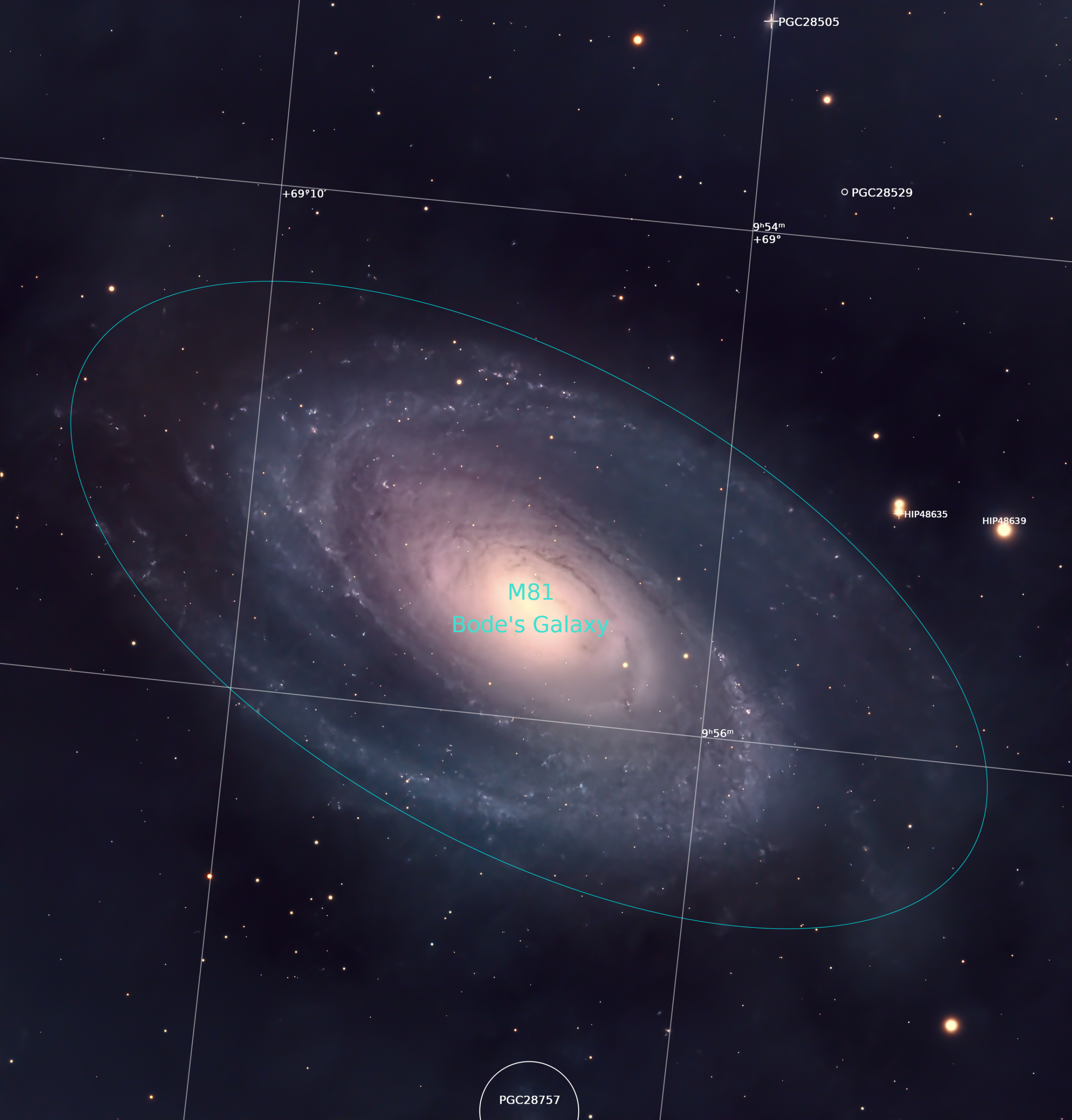
Acquisition details
Equipment
Telescope : Celestron Edge 8HD
Mount : Skywatcher EQ6r Pro
Camera : ZWO 522mm
Filters : Anitlia 4.5 Nm Ultra filters Ha, Oiii, Sii
Dates : 15/03/2025 – 28/03/2025
Frames : R*73, G*33, B*38, L*81 Exposure times 100
Total Time : 6Hrs 15 Minutes