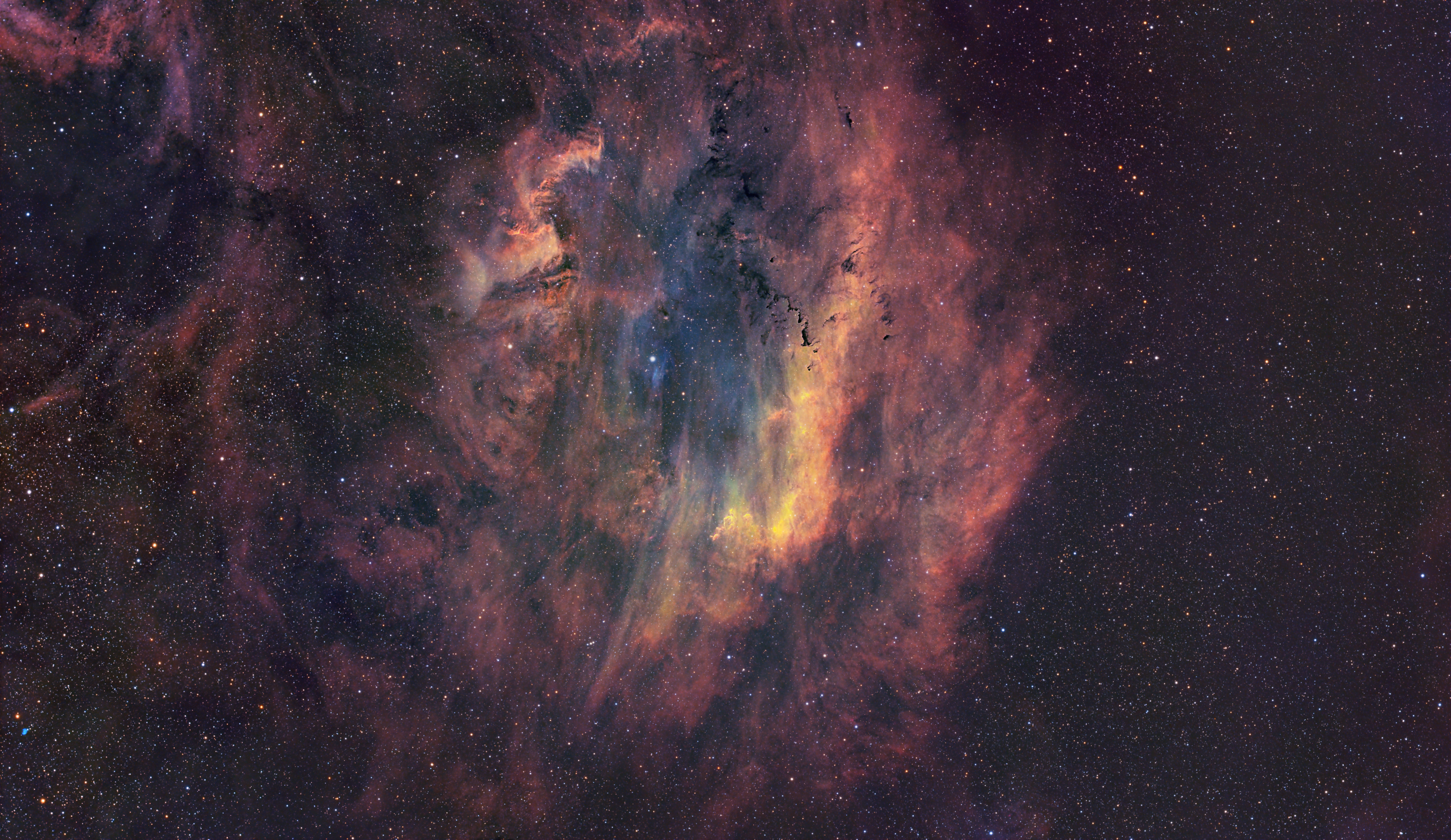
Sh2-119: The Clamshell Nebula
Sh2-119, also known as Sharpless 119 or the Clamshell Nebula, is a large and fascinating emission nebula located in the constellation Cygnus, the Swan. Although it is relatively close to the famous North America Nebula, Sh2-119 receives much less attention from astronomers and astrophotographers. Its faint, complex structure makes it a challenging object to observe, but also one of considerable beauty and scientific interest.
Sh2-119 is a vast region of glowing interstellar gas and dust. It is classified as an H II region, meaning that much of its hydrogen has been ionised by intense ultraviolet radiation from nearby hot stars. When electrons recombine with hydrogen ions, the gas releases light, particularly in the red H-alpha wavelength. This is why photographs of Sh2-119 often reveal extensive red and pink areas of nebulosity. The nebula also contains dark regions where clouds of dust obscure the light behind them, creating striking contrasts within the larger cloud.
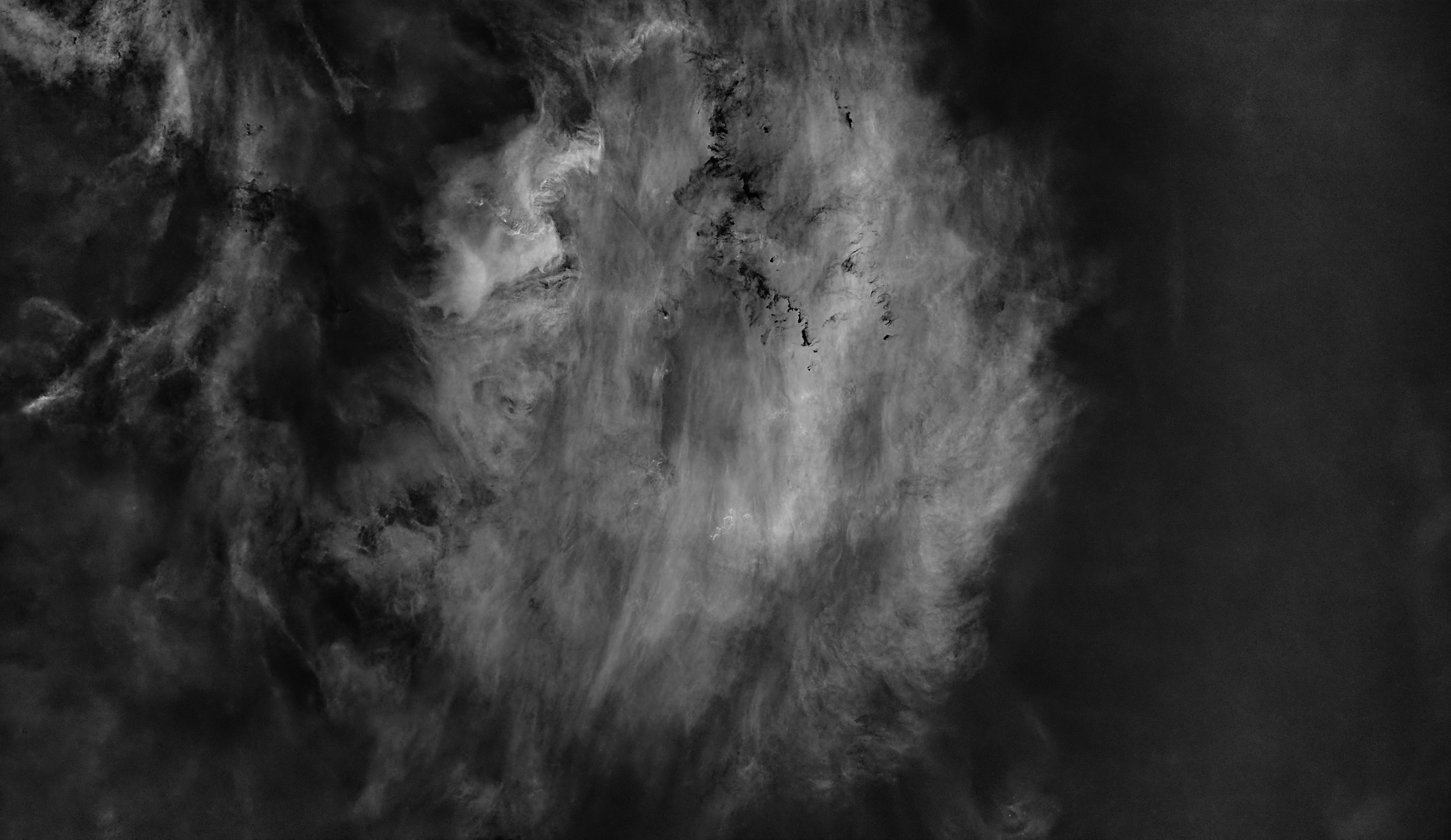
The nebula was catalogued by American astronomer Stewart Sharpless as part of the Catalogue of H II Regions, published in 1959. The catalogue was created from astronomical photographic surveys and included numerous regions of ionised hydrogen throughout the Milky Way. Sh2-119 had actually been noticed in earlier surveys, but Sharpless’s catalogue gave the object the designation by which it is commonly known today
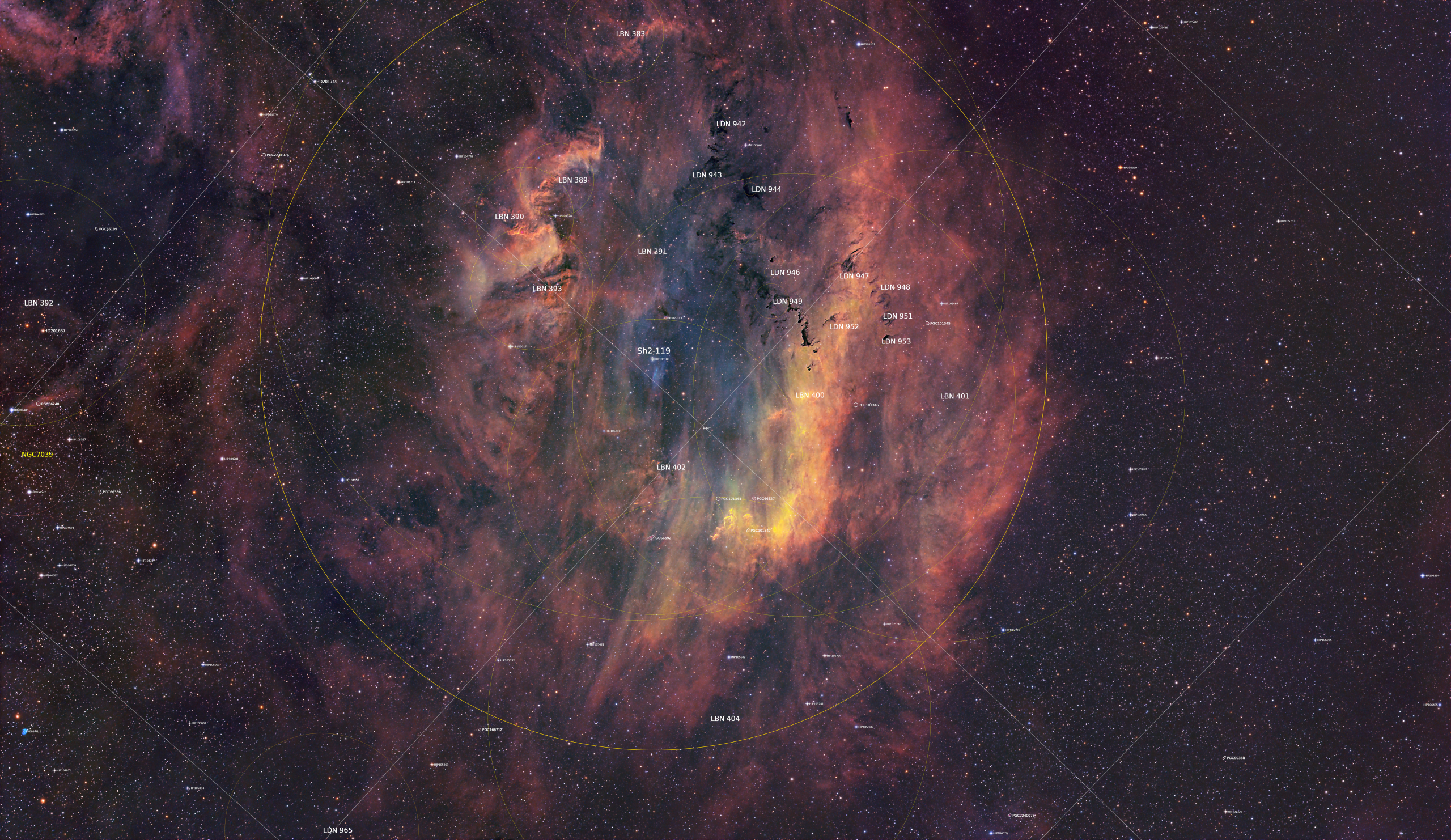
One of the most prominent stars associated with Sh2-119 is 68 Cygni, also known as HD 203064. It is a bright fifth-magnitude star situated near the centre of the nebula. Astronomical studies and observing references identify 68 Cygni as an important source of the radiation responsible for ionising the surrounding gas. Some descriptions identify it as an O-type star whose powerful ultraviolet radiation and stellar winds have helped shape the surrounding nebular material.
The distance to Sh2-119 is not represented by a single universally quoted value in popular astronomy sources. Estimates commonly place it roughly 2,000–2,200 light-years from Earth, while some catalogues give approximately 700 parsecs, equivalent to about 2,280 light-years. At this distance, its apparent size of roughly two degrees across corresponds to a truly enormous physical structure, spanning several tens of light-years
One of the most interesting features of Sh2-119 is its shape. The nebula appears to form large shell-like structures around 68 Cygni, with the eastern portion being particularly extensive. Dark lanes and globules of dust cut through the glowing gas, especially toward the southern regions. These structures give the nebula its informal name, the Clamshell Nebula, because some views of the object resemble the curved shells of a clam.
Sh2-119 is also an excellent example of how stars can influence their surroundings. Massive stars do not simply sit inside clouds of gas; their ultraviolet radiation and stellar winds can heat, ionise, compress and disperse nearby material. Over millions of years, these processes can transform a relatively uniform molecular cloud into the intricate collection of bright and dark structures seen in nebulae such as Sh2-119. In this way, the nebula provides astronomers with an opportunity to study the interaction between massive stars and the interstellar medium.
Despite its enormous size, Sh2-119 is relatively difficult to see visually. Its light is spread across a large area of sky, making its surface brightness low. It is also surrounded by a rich Milky Way star field and lies close to much more famous targets, including the North America Nebula and the Pelican Nebula. Consequently, astrophotographers have historically photographed Sh2-119 less frequently than its brighter neighbours. Long-exposure photography, particularly through narrowband filters that isolate H-alpha and other emission lines, can reveal details that are extremely difficult to see with the human eye.
In conclusion, Sh2-119 is a remarkable example of the enormous and dynamic structures that exist within our Galaxy. Its glowing hydrogen, dark dust clouds and shell-like form demonstrate the powerful influence that massive stars can have on their environment. Although it may be overshadowed by the more famous nebulae of Cygnus, Sh2-119 rewards closer examination with a complex landscape of gas, dust and stars. The Clamshell Nebula therefore represents not only a beautiful astronomical target, but also a fascinating laboratory for understanding how stars and interstellar clouds interact across enormous distances and timescales.
Acquisition details
Equipment
Telescope : William Optics 81GT
Mount : Skywatcher EQ6r Pro
Camera : ZWO 6200mm pro
Filters : Anitlia 2.5 Nm Ultra filters Ha, Oiii, Sii
Dates : 17/07/2026 – 20/08/2026
Frames : HA 300*40, Oiii 300*58, Sii 300*30
Total Time : 10Hrs 40 Minutes