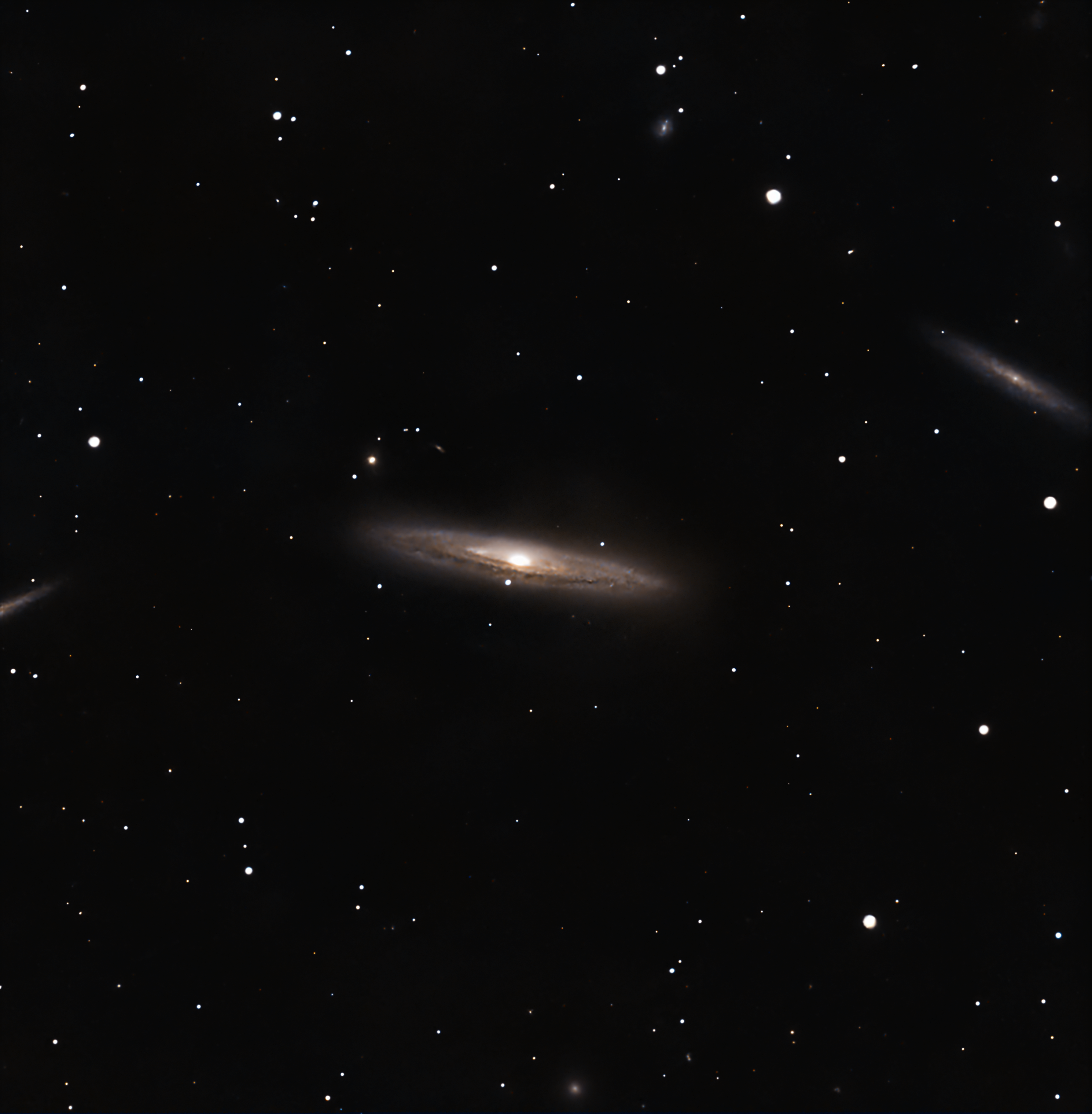
NGC 4216 is a metal-rich intermediate spiral galaxy located not far from the center of the Virgo Cluster of galaxies, roughly 55 million light-years away. It was discovered by German-British astronomer William Herschel on 17 April 1784.
Seen nearly edge-on, NGC 4216 is one of the largest and brightest spiral galaxies of the Virgo Cluster, with an absolute magnitude that has been estimated to be −22 (i.e.: brighter than the Andromeda Galaxy), and like most spiral galaxies of this cluster shows a deficiency of neutral hydrogen that is concentrated within the galaxy’s optical disk and has a low surface density for a galaxy of its type. This explains why NGC 4216 is considered an anemic galaxy by some authors, also with a low star formation activity for a galaxy of its type. In fact, the galaxy’s disk shows pillar-like structures that may have been caused by interactions with the intracluster medium of Virgo and/or with nearby galaxies.
In NGC 4216’s halo, besides a rich system of globular clusters estimated to number around 700 (nearly five times more than the Milky Way), two stellar streams that are interpreted as two satellite galaxies being disrupted and absorbed by this galaxy are present.
NGC 4216 seems to be in a place of the Virgo cluster where dwarf galaxies are being destroyed/accreted at a high rate, with it suffering many interactions with these type of galaxies.
One supernova has been observed in NGC 4216: SN 2024gy (type Ia, mag. 16.3) was discovered by Kōichi Itagaki on 4 January 2024.
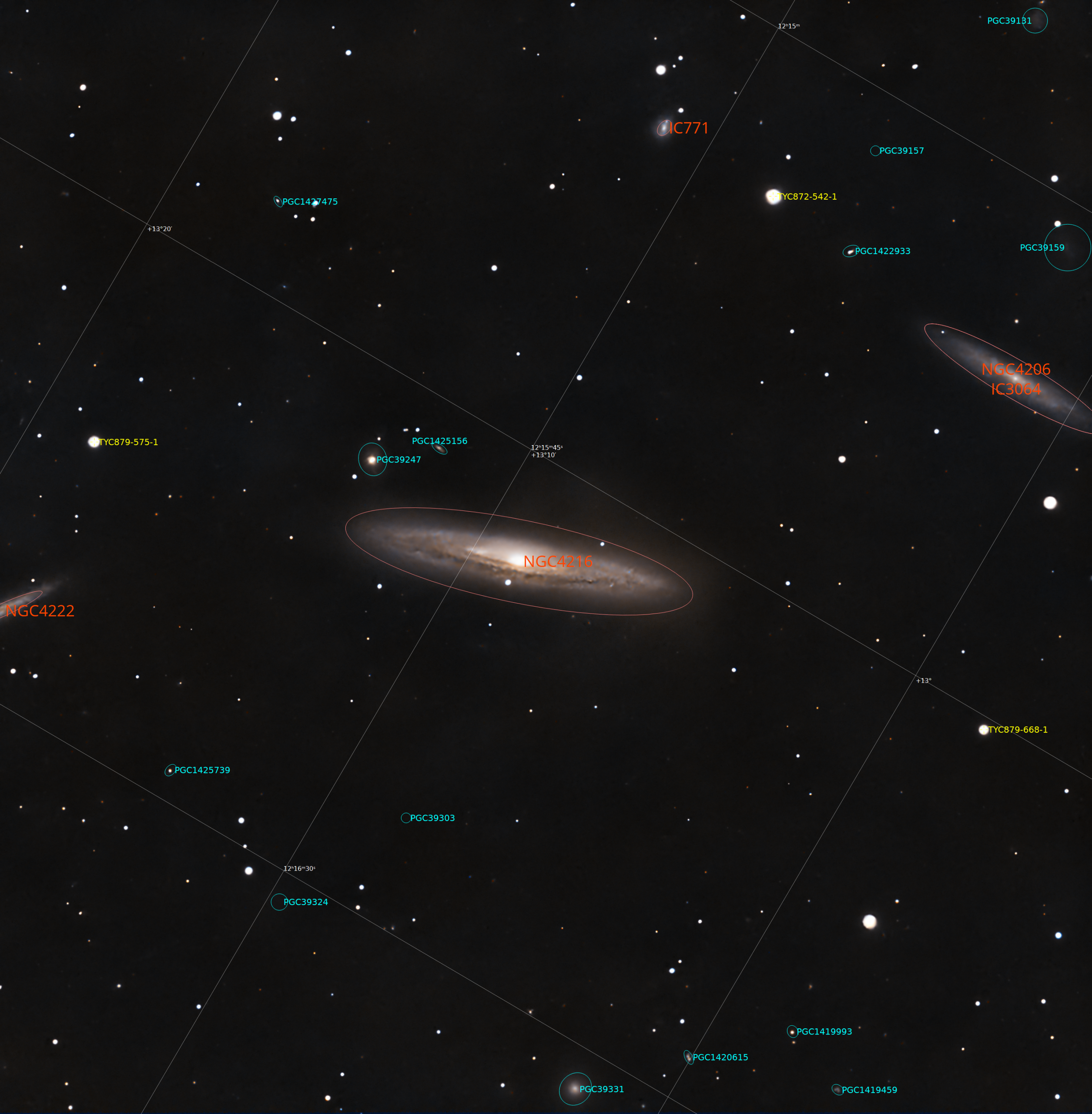
NGC 4216, along with NGC 4206, NGC 4222, and IC 771, are listed together as Holm 353 in Erik Holmberg’s A Study of Double and Multiple Galaxies Together with Inquiries into some General Metagalactic Problems, published in 1937.
Annotated Image
Aquisition Data
Telescope : CelestronEdge8Hd
Imaging Camera : ZWO ASI533mm Pro
Filters :Antillia R,G,B Crystal Clear Glass
Mount : Skywatcher EQ6r Pro (tuned)
Exposure : 120seconds
Gain : 90
R : 45, G : 23, B : 52, L : 41
Date : May 2025
| Observation data (J2000 epoch) | |
|---|---|
| Constellation | Virgo |
| Right ascension | 12h 15m 54.3728s |
| Declination | +13° 08′ 58.08″ |
| Redshift | 0.000437 |
| Distance | 55 Mly |
| Apparent magnitude (V) | 11.0 |
| Characteristics | |
| Type | SAB(s)b |
| Apparent size (V) | 8.1′ × 1.8′ |
| Other designations | |
| VCC 167, HOLM 353A, IRAS 12133+1325, UGC 7284, MCG +02-31-072, PGC 39246, CGCG 069-112 | |