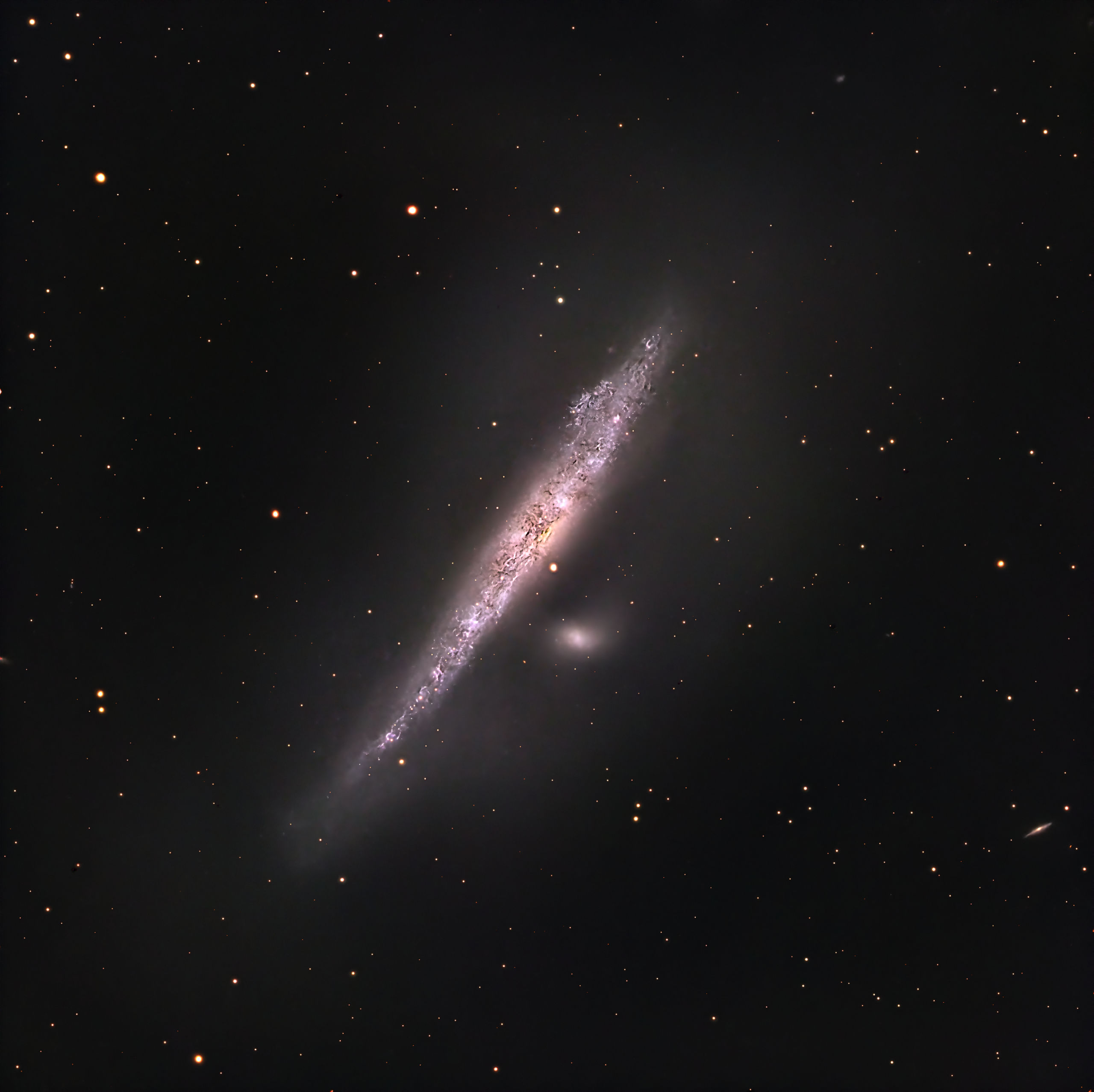
NGC 4631 (also known as the Whale Galaxy or Caldwell 32) is a barred spiral galaxy in the constellation Canes Venatici about 30 million light years away from Earth. It was discovered on 20 March 1787 by German-British astronomer William Herschel This galaxy’s slightly distorted wedge shape gives it the appearance of a herring or a whale, hence its nickname. Because this nearby galaxy is seen edge-on from Earth, professional astronomers observe this galaxy to better understand the gas and stars located outside the plane of the galaxy.
NGC 4631 contains a central starburst, which is a region of intense star formation. The strong star formation is evident in the emission from ionized hydrogen and interstellar dust heated by the stars formed in the starburst. The most massive stars that form in star formation regions only burn hydrogen gas through fusion for a short period of time, after which they explode as supernovae. So many supernovae have exploded in the center of NGC 4631 that they are blowing gas out of the plane of the galaxy. This superwind can be seen in X-rays and in spectral line emission.The gas from this superwind has produced a giant, diffuse corona of hot, X-ray emitting gas around the whole galaxy.
Although no supernovae have been observed in NGC 4631 yet, a luminous red nova, designated AT 2021biy, was discovered on 29 January 2021 (type LRN, mag. 18.1).
Nearby galaxies and galaxy group
NGC 4631 has a nearby companion dwarf elliptical galaxy, NGC 4627. NGC 4627 and NGC 4631 together were listed in the Atlas of Peculiar Galaxies as an example of a “double galaxy” or a galaxy pair.
NGC 4631 and NGC 4627 are part of the NGC 4631 Group, a group of galaxies that also includes the interacting galaxies NGC 4656 and NGC 4657 However, exact group identification is problematic because this galaxy and others lie in a part of the sky that is relatively crowded. Estimates of the number of galaxies in this group range from 5 to 27, and all studies identify very different member galaxies for this group.
| Observation data (J2000 epoch) | |
|---|---|
| Constellation | Canes Venatic |
| Right ascension | 12h 42m 08.0s |
| Declination | +32° 32′ 29″ |
| Redshift | 606 ± 3 km/s |
| Distance | 30 Mly |
| Apparent magnitude (V) | 9.8 |
| Characteristics | |
| Type | SB(s)d |
| Apparent size (V) | 15′.5 × 2′.7 |
| Notable features | edge-on |
| Other designations | |
| Whale Galaxy, Arp 281, UGC 7865, PGC 42637, Caldwell 32 | |
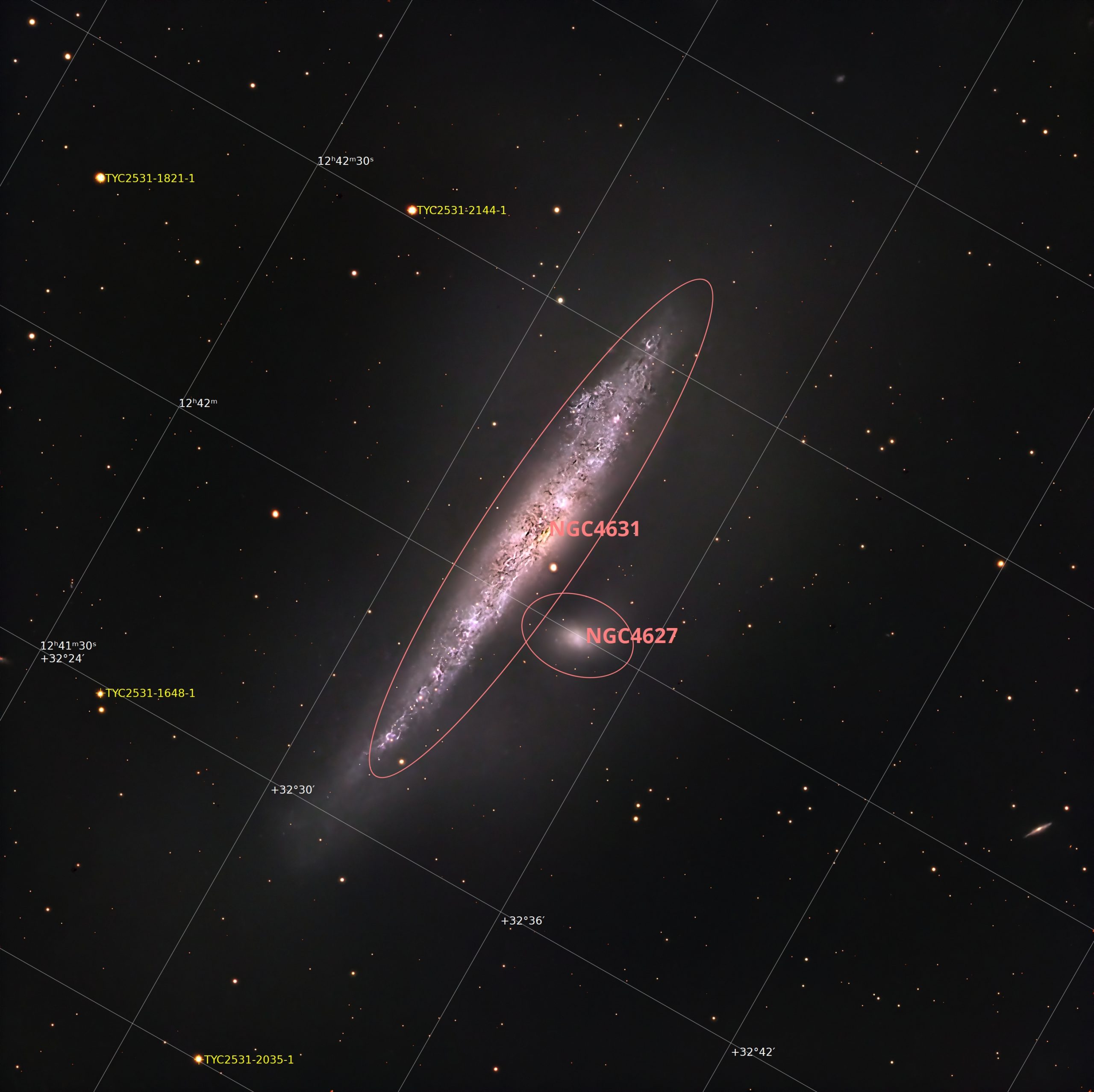
Aquisition Data
Telescope : CelestronEdge8Hd
Imaging Camera : ZWO ASI533mm Pro
Filters :Antillia R,G,B Crystal Clear Glass
Mount : Skywatcher EQ6r Pro (tuned)
Exposure : 120seconds
Gain : 90
R : 50, G : 26, B : 56, L : 111
Date : May 2025